

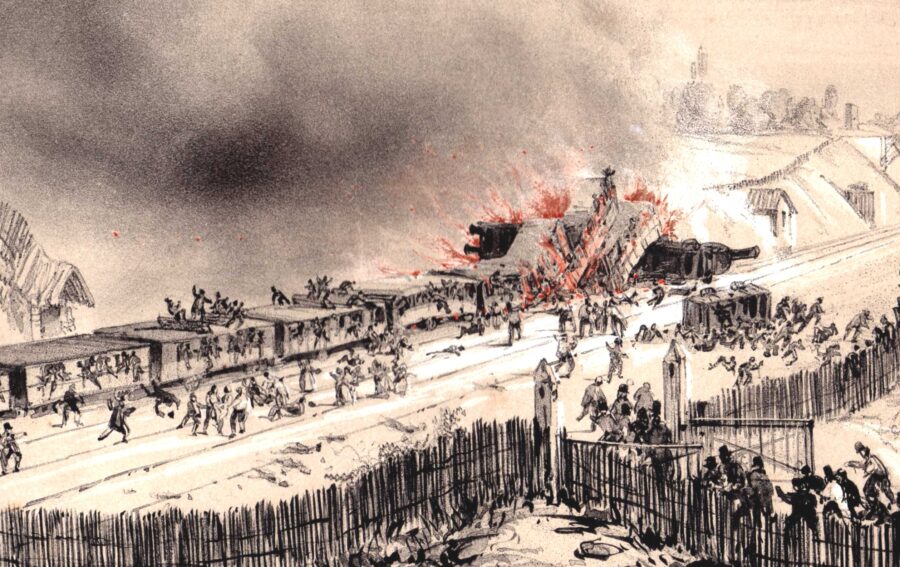
(This article contains heavy spoilers for the first season of HBO’s ‘The Last of Us’ and some mild spoilers for NBC’s ‘The Good Place’.)
Gentlemen, lend me your ears. More accurately, lend me your moral intuitions and a sturdy pair of spectacles, for we are about to peer down the railway tracks of the most famous and deliciously tormenting ethical conundrum in modern history: The Trolley Problem.
It is a thought experiment so perfect, so simple in its terror, that it has spawned an entire field of inquiry known colloquially as “Trolleyology.” It is the philosophical equivalent of a perfectly mixed cocktail: two parts Utilitarianism, one part Deontology, garnished with the grisly prospect of a decision made in panic.
One Foot in Front of the Other
The problem, in its pristine form, was laid down by the British philosopher Philippa Foot in 1967. Imagine, if you will, a runaway trolley hurtling down the main track. Ahead, five hapless workers are tied down, oblivious to their fate. You, a mere bystander, stand next to a lever. If you pull it, you will divert the trolley onto a side track. The catch? There is one person tied to that side track.
The choice is stark and cleanly arithmetic: do nothing, and five die, or pull the lever, and one dies.
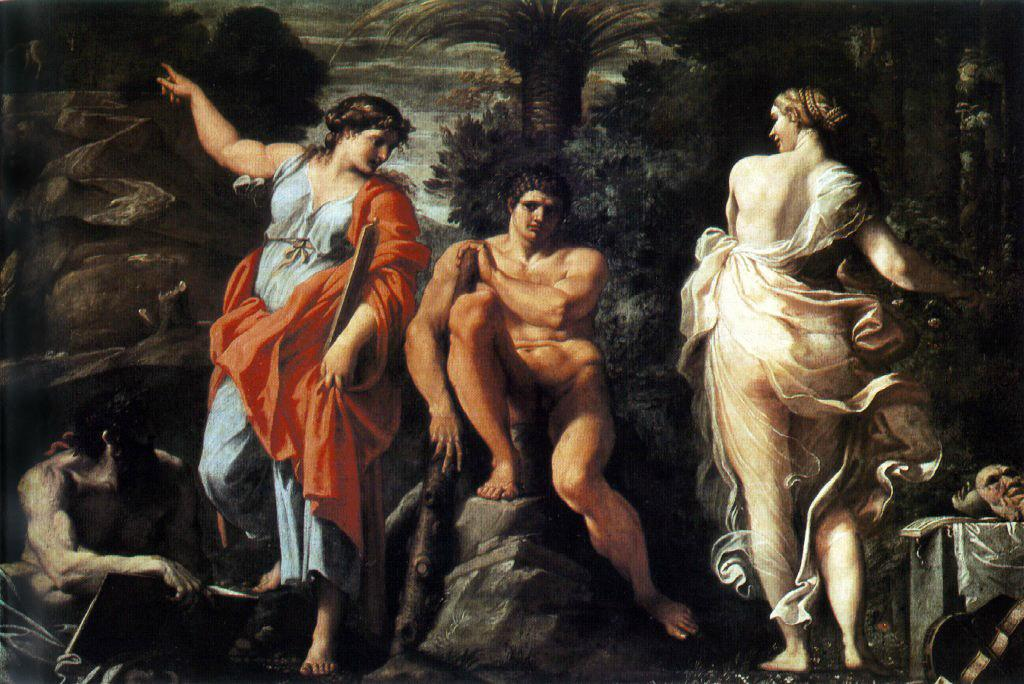
Most people, when presented with this scenario, opt to pull the lever. It is the cold, hard logic of Utilitarianism: the moral choice is the one that maximizes overall good, or in this case, minimizes the death toll. Five lives saved, one lost. A regrettable net gain of four human souls. It is a decision rooted in the principle of beneficence (the duty to do good), pitted against the principle of non-maleficence (the duty to do no harm).
But philosophy, like a good single malt, is never satisfied with the first sip. This initial case, while troubling, merely set the stage for the true torment.
What Did the Poor Fat Man Do?
Here is where we introduce the man who, through no fault of his own, became a philosophical meme. Allow me to present the Footbridge Case, later popularized by philosopher Judith Jarvis Thomson:
The trolley is still hurtling toward the five. This time, however, you are standing on a footbridge overlooking the track. There is no switch. Next to you stands a man of considerable girth. A man, shall we say, sufficiently hefty to stop the trolley if he were to fall onto the tracks.
Now, the question is: Would you push him?
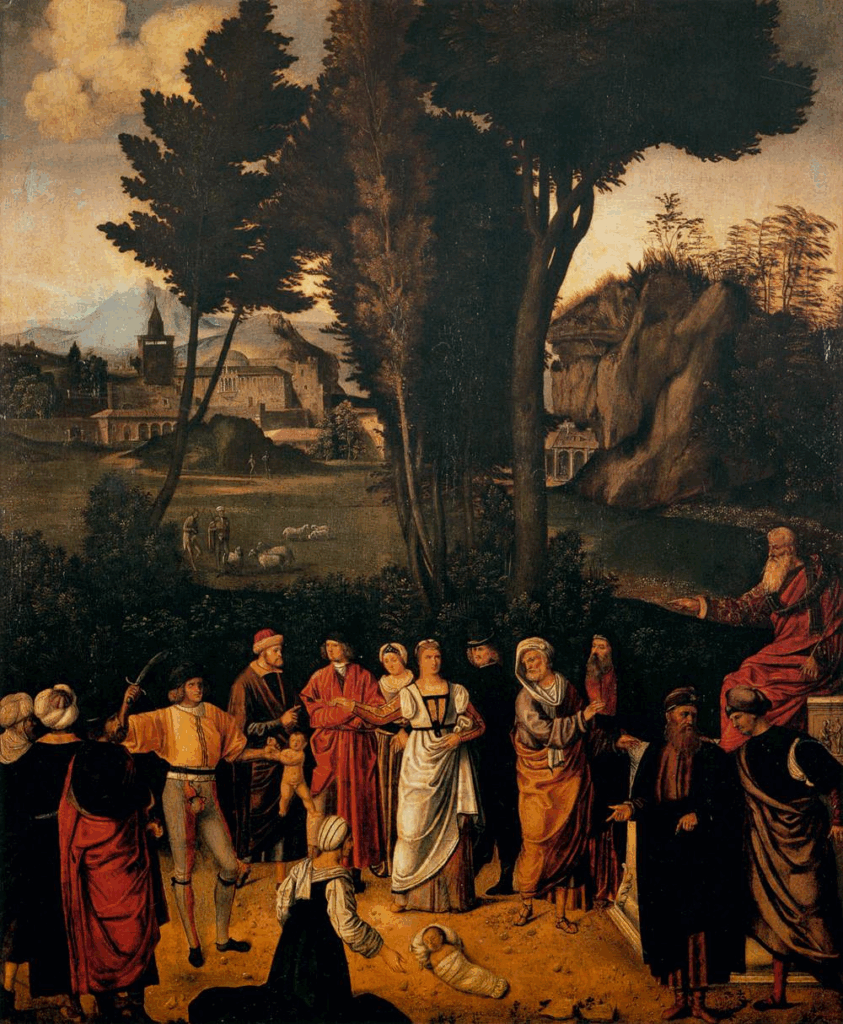
The equation is identical: one death to save five. Yet, a large majority of those who would happily pull the lever in the first scenario recoil in horror from pushing the man.
Why the visceral difference? This is the luscious heart of the problem.
For Foot, the key lay in the distinction between two kinds of duties: negative duties (duties not to harm) and positive duties (duties to aid). She argued that the negative duty not to directly kill the man is a more stringent moral claim than the positive duty to save the five.
The Harvard paper on the subject (an “Exercise in Moral & Legal Reasoning,” no less) highlights the elegant analytical maneuver that separates the two cases.
In the original trolley case, by pulling the switch, you are merely redirecting a pre-existing threat. You are choosing between two undesirable outcomes that are already in motion. In the Footbridge Case, however, you are introducing a new threat: you are actively using the innocent man as a means to an end, a human brake-pad, which violates the Kantian principle of treating humanity never merely as a means, but always as an end in itself.The poor, fat man is a philosophical lightning rod, forcing us to admit that morality is not just a numbers game; it is also about how we choose to kill, or, perhaps, how we manage to not kill.
Ethical Problems Too Abstract. Might I Interest You in a Hyper-Realistic Simulation?
For those who find such abstract reasoning a bit too clean for a high-stakes ethical slaughter, one need only turn to the afterlife bureaucracy of NBC’s ‘The Good Place’.
The demon-turned-ethics-student Michael, fed up with the airy nature of Chidi Anagonye’s lectures on moral philosophy, decides to make the thought experiment a real experience. He constructs a hyper-realistic, fully immersive simulation of the trolley problem in a Season 2 episode, “The Trolley Problem”.
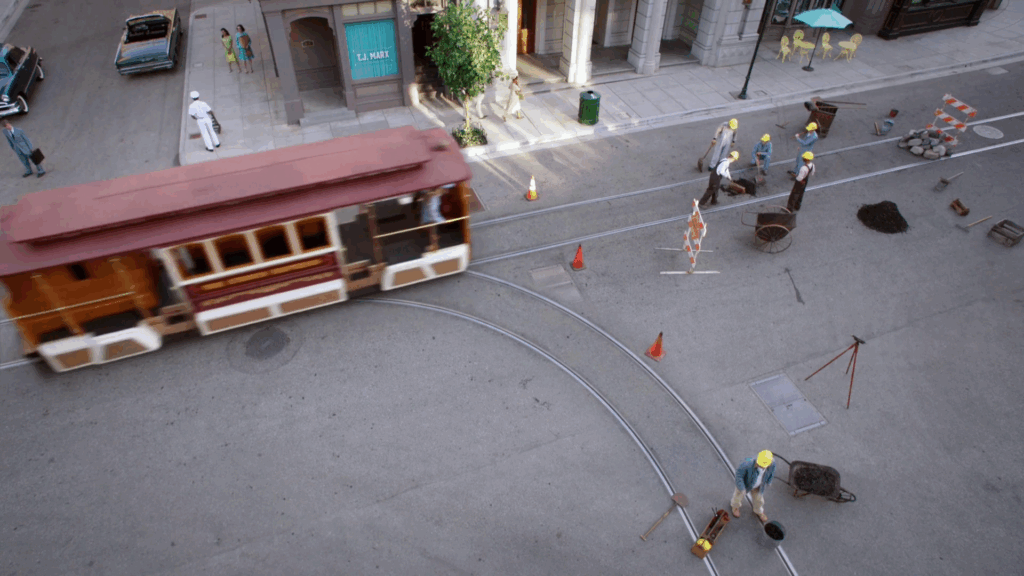
Chidi, the indecisive moral philosopher, is placed at the controls. He is forced to repeatedly choose whether to kill one or five, and his classic paralysis causes him to freeze, resulting in the death of the five workmen by omission. The trauma is compounded when Michael ups the ante, making the single victim a man Chidi knows, his “boot-buddy” Henry, whose bloody boot (and “guts”) splatter Chidi’s face upon impact.
The brilliance of The Good Place is its tongue-in-cheek thesis that context is catastrophe. The show argues that ethical purity is impossible in the messy, hyper-contingent reality of human life. By the end of the simulation, Chidi is a broken man, realizing that intellectual knowledge of an ethical dilemma does little to steel one’s nerves when faced with the visceral reality of commission. Abstract morality is easy; real morality is a splatter of guts and existential dread.
Love and Heartbreak in the Times of an Apocalypse
But what happens when the trolley problem stops being about a random stranger and becomes about the only person who makes an impossible world bearable?
The climax of the first season of HBO’s ‘The Last of Us’ is, in essence, an inversion of the classic utilitarian dilemma. Joel Miller has shepherded Ellie, a young girl who is immune to the Cordyceps infection, across an apocalyptic America. When they reach the Fireflies’ hospital, he learns the terrible choice: the only way to synthesize a vaccine is to kill Ellie by removing the part of her brain where the immune fungus grows.

The choice is Utilitarianism’s Triumph (Ellie’s death to save the world/the many) versus Personal Deontology’s Defiance (Ellie’s life, protected by Joel’s violence, dooming the world/the many).
Joel’s decision is the ultimate anti-trolley problem. He doesn’t merely refuse to pull the lever; he pulls the emergency brake, sets the entire train on fire, and murders the conductor (and a few dozen track workers) to save the one. He chooses the individual love he has found over the abstract duty to save humanity. It is an affirmation that for a human being, especially one consumed by grief and attachment, morality is not a simple equation. It is a messy, deeply selfish, and human choice.
They Are Studying This Concept for What Now?
The most bizarre, and yet most real, application of the Trolley Problem today has moved from the philosophy seminar to the engineering lab: How do we program a driverless car (AV) to handle an unavoidable accident?.
Should the car be programmed to be a utilitarian hero, swerving to save a busload of schoolchildren at the expense of its lone passenger (you)? Or should it be loyal to its owner, protecting the passenger at all costs (including the school bus)? For a delicious come-aliving of this dilemma, read Shehan Karunatilaka’s story, A Self-Driving Car’s Thoughts As It Crashes, collected in The Birth Lottery and Other Stories (pub. 2022).
This is a dilemma so immediate that policymakers have weighed in. The German Ethics Commission for Automated and Connected Driving, for example, has declared that autonomous systems should not be allowed to distinguish between people based on personal characteristics such as age, gender, or profession when making an unavoidable collision decision. The car, they seem to argue, must be ethically blind, which effectively rules out the very possibility of the utilitarian calculus that defines the problem.
However, the industry itself often dismisses the entire exercise as a “misguided dilemma”. They argue that AVs, unlike runaway trolleys, are designed to drive so safely that an unavoidable, split-second, five-versus-one catastrophe is a statistical near-impossibility. The real ethical concerns are far more mundane, yet insidious: Who is liable for an accident? And how do we build the system’s “social contract” with human drivers?
In the Eye of the Hurricane
So, after all this deliberation, after the trolley, the fat man, the comedy, the apocalypse, and the autonomous vehicle, do we have a solution?
No. And that, dear reader, is the magnificent point.
The great value of the Trolley Problem is not in finding a universally acceptable answer. Most philosophers indeed agree that one doesn’t exist. Its value lies in the “Exercise in Moral & Legal Reasoning” it facilitates. The problem forces us to articulate our reasons, test our principles against different cases, and observe how a slight change in circumstance—from flipping a lever to pushing a man—upends the entire moral framework.
The ultimate conclusion of Trolleyology is that human morality is not a monolithic theorem but a tension between competing, powerful urges: the logical urge to save the many and the human, emotional urge to avoid causing direct, personal harm. In the end, the question is maybe not what you would do, but why you would do it.
And until the day an AI solves the conundrum to the satisfaction of both Immanuel Kant and a grieving father in a post-apocalyptic wasteland, the trolley will keep rattling down the track, forever testing the structural integrity of our ethics, one scrumptious, horrific scenario at a time.
References:
[1.1] A little twist that puts the so-called “trolley problem” in perspective: r/TheLastOfUs2. (2023). https://www.reddit.com/r/TheLastOfUs2/comments/15e69ti/a_little_twist_that_puts_the_socalled_trolley/
[1.2] Morals of TLOU and The Trolley Problem: r/TheLastOfUs2. (2023). https://www.reddit.com/r/TheLastOfUs2/comments/112iiyl/morals_of_tlou_and_the_trolley_problem/
[1.4] Much like 10 years ago, some people arguing the ending always miss the point: The Last of Us is one big trolley problem, and you can’t invent a third option to get away from it.: r/thelastofus. (2023). https://www.reddit.com/r/thelastofus/comments/11qno3j/much_like_10_years_ago_some_people_arguing_the/
[1.5] The Last of Us and The Trolley Problem. (2025). https://www.youtube.com/watch?v=jHx5u8KiAEM
[2.1] Trolley problem – Wikipedia. https://en.wikipedia.org/wiki/Trolley_problem
[2.2] Could There Be A Solution To The Trolley Problem? | Issue 116 – Philosophy Now. (2016). https://philosophynow.org/issues/116/Could_There_Be_A_Solution_To_The_Trolley_Problem
[2.3] Medical ethics and the trolley Problem – PMC – PubMed Central. (2019). https://pmc.ncbi.nlm.nih.gov/articles/PMC6642460/
[2.4] A Solution to the Trolley Problem | Issue 154 – Philosophy Now. https://philosophynow.org/issues/154/A_Solution_to_the_Trolley_Problem
[2.9] Is there an “accepted” answer in philosophy on the trolley problem? Is this a solved question? : r/askphilosophy. (2023). https://www.reddit.com/r/askphilosophy/comments/18pgugm/is_there_an_accepted_answer_in_philosophy_on_the/
[3.2] Trolley problem | Definition, Variations, Arguments, Solutions, & Facts | Britannica. (2025). https://www.britannica.com/topic/trolley-problem
[3.5] Trolley problem | Research Starters – EBSCO. https://www.ebsco.com/research-starters/religion-and-philosophy/trolley-problem
[1.4] The misguided dilemma of the trolley problem – Volvo Autonomous Solutions. (2024). https://www.volvoautonomoussolutions.com/en-en/news-and-insights/insights/articles/2024/jan/the-misguided-dilemma-of-the-trolley-problem-.html
[1.5] Designing Ethical Self-Driving Cars | Stanford HAI. (2023). https://hai.stanford.edu/news/designing-ethical-self-driving-cars
[1.6] Ethical Considerations of the Trolley Problem in Autonomous Driving: A Philosophical and Technological Analysis – MDPI. (2024). https://www.mdpi.com/2032-6653/15/9/404
[1.8] To Help Autonomous Vehicles Make Moral Decisions, Researchers Ditch the ‘Trolley Problem’ | NC State News. (2023). https://news.ncsu.edu/2023/12/ditching-the-trolley-problem/
[2.2] The Trolley Problem – The Good Place (Season 2, Episode 5) – Apple TV. https://tv.apple.com/us/episode/the-trolley-problem/umc.cmc.602v0v7rfhea6m2jvgsuzbmze?showId=umc.cmc.361pp6dpt0jsmj9sxywuiw665
[2.3] The Good Place Unlocked: Season 2 Episode 6, “The Trolley Problem” – Overthinking It. (2017). https://www.overthinkingit.com/2017/10/23/the-good-place-locked-season-2-episode-6-the-trolley-problem/
[2.4] Chidi wrestles with “The Trolley Problem” on a brilliantly funny The Good Place – AV Club. (2017). https://www.avclub.com/chidi-wrestles-with-the-trolley-problem-on-a-brillian-1819677918