Author: Nilay Bhatt

The Trolley Problem and the Scrumptious Bizarreness of a Thought Experiment

(This article contains heavy spoilers for the first season of HBO’s ‘The Last of Us’ and some mild spoilers for NBC’s ‘The Good Place’.)

Gentlemen, lend me your ears. More accurately, lend me your moral intuitions and a sturdy pair of spectacles, for we are about to peer down the railway tracks of the most famous and deliciously tormenting ethical conundrum in modern history: The Trolley Problem.

It is a thought experiment so perfect, so simple in its terror, that it has spawned an entire field of inquiry known colloquially as “Trolleyology.” It is the philosophical equivalent of a perfectly mixed cocktail: two parts Utilitarianism, one part Deontology, garnished with the grisly prospect of a decision made in panic.

One Foot in Front of the Other

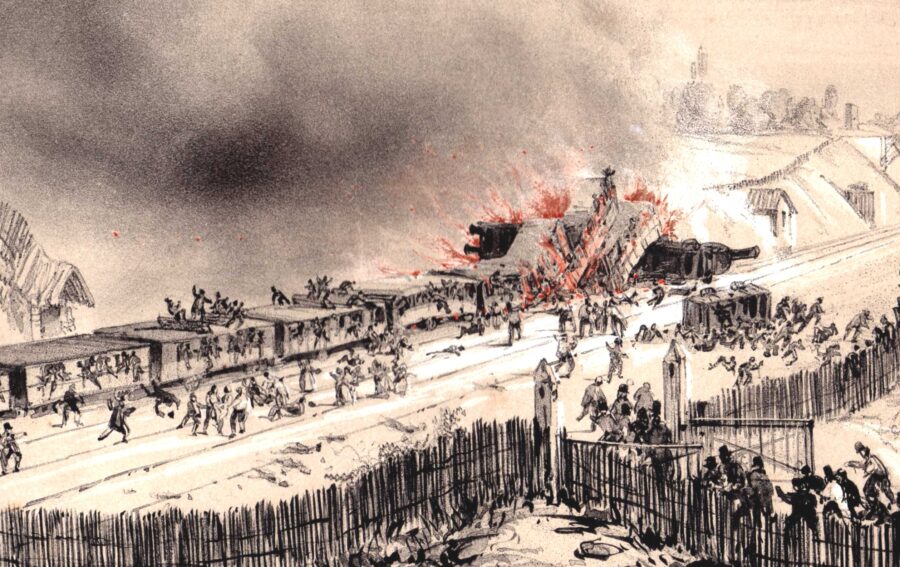
The problem, in its pristine form, was laid down by the British philosopher Philippa Foot in 1967. Imagine, if you will, a runaway trolley hurtling down the main track. Ahead, five hapless workers are tied down, oblivious to their fate. You, a mere bystander, stand next to a lever. If you pull it, you will divert the trolley onto a side track. The catch? There is one person tied to that side track.

The choice is stark and cleanly arithmetic: do nothing, and five die, or pull the lever, and one dies.
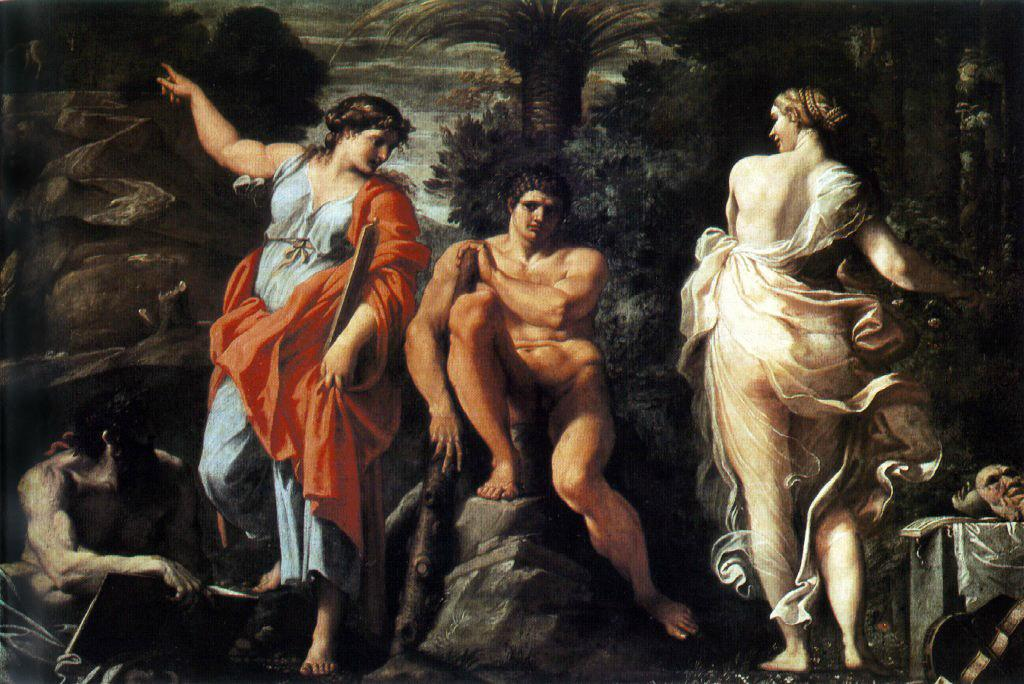
The Choice of Hercules by Annibale Carracci (1596)

Most people, when presented with this scenario, opt to pull the lever. It is the cold, hard logic of Utilitarianism: the moral choice is the one that maximizes overall good, or in this case, minimizes the death toll. Five lives saved, one lost. A regrettable net gain of four human souls. It is a decision rooted in the principle of beneficence (the duty to do good), pitted against the principle of non-maleficence (the duty to do no harm).

But philosophy, like a good single malt, is never satisfied with the first sip. This initial case, while troubling, merely set the stage for the true torment.

What Did the Poor Fat Man Do?

Here is where we introduce the man who, through no fault of his own, became a philosophical meme. Allow me to present the Footbridge Case, later popularized by philosopher Judith Jarvis Thomson:

The trolley is still hurtling toward the five. This time, however, you are standing on a footbridge overlooking the track. There is no switch. Next to you stands a man of considerable girth. A man, shall we say, sufficiently hefty to stop the trolley if he were to fall onto the tracks.

Now, the question is: Would you push him?
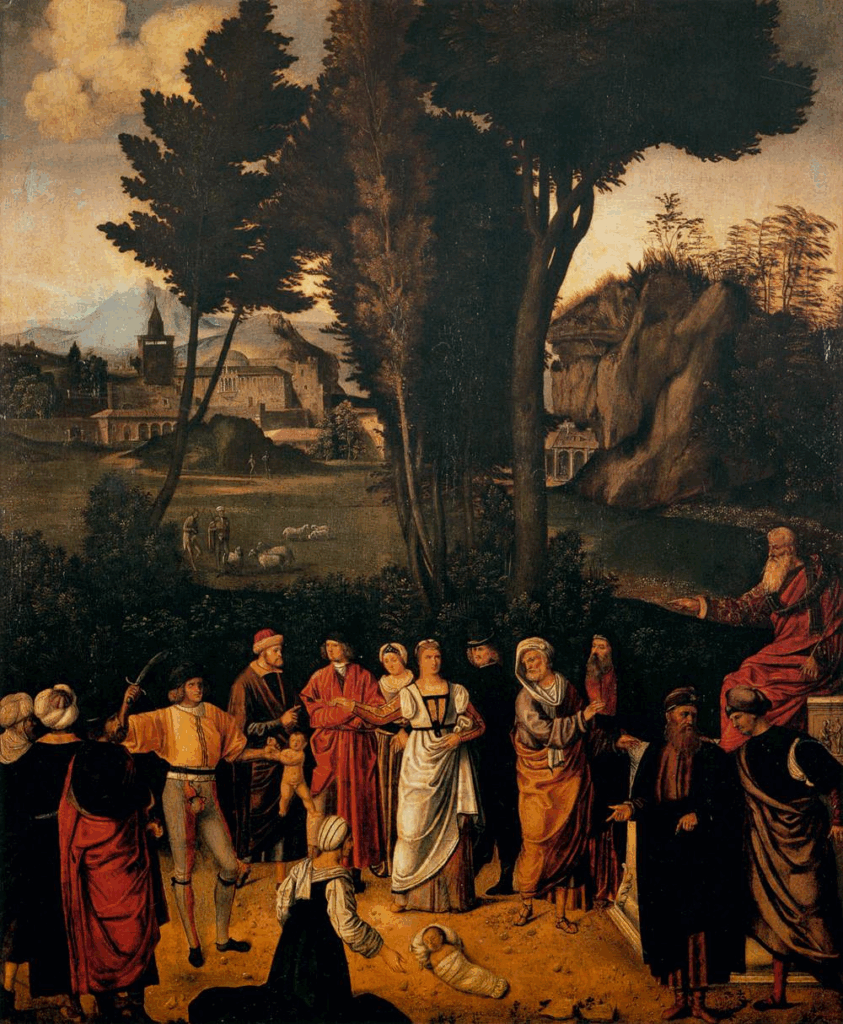
The Judgement of Solomon by Giorgione (1500)

The equation is identical: one death to save five. Yet, a large majority of those who would happily pull the lever in the first scenario recoil in horror from pushing the man.

Why the visceral difference? This is the luscious heart of the problem.

For Foot, the key lay in the distinction between two kinds of duties: negative duties (duties not to harm) and positive duties (duties to aid). She argued that the negative duty not to directly kill the man is a more stringent moral claim than the positive duty to save the five.

The Harvard paper on the subject (an “Exercise in Moral & Legal Reasoning,” no less) highlights the elegant analytical maneuver that separates the two cases. 

In the original trolley case, by pulling the switch, you are merely redirecting a pre-existing threat. You are choosing between two undesirable outcomes that are already in motion. In the Footbridge Case, however, you are introducing a new threat: you are actively using the innocent man as a means to an end, a human brake-pad, which violates the Kantian principle of treating humanity never merely as a means, but always as an end in itself.The poor, fat man is a philosophical lightning rod, forcing us to admit that morality is not just a numbers game; it is also about how we choose to kill, or, perhaps, how we manage to not kill.

Ethical Problems Too Abstract. Might I Interest You in a Hyper-Realistic Simulation?

For those who find such abstract reasoning a bit too clean for a high-stakes ethical slaughter, one need only turn to the afterlife bureaucracy of NBC’s ‘The Good Place’.

The demon-turned-ethics-student Michael, fed up with the airy nature of Chidi Anagonye’s lectures on moral philosophy, decides to make the thought experiment a real experience. He constructs a hyper-realistic, fully immersive simulation of the trolley problem in a Season 2 episode, “The Trolley Problem”.
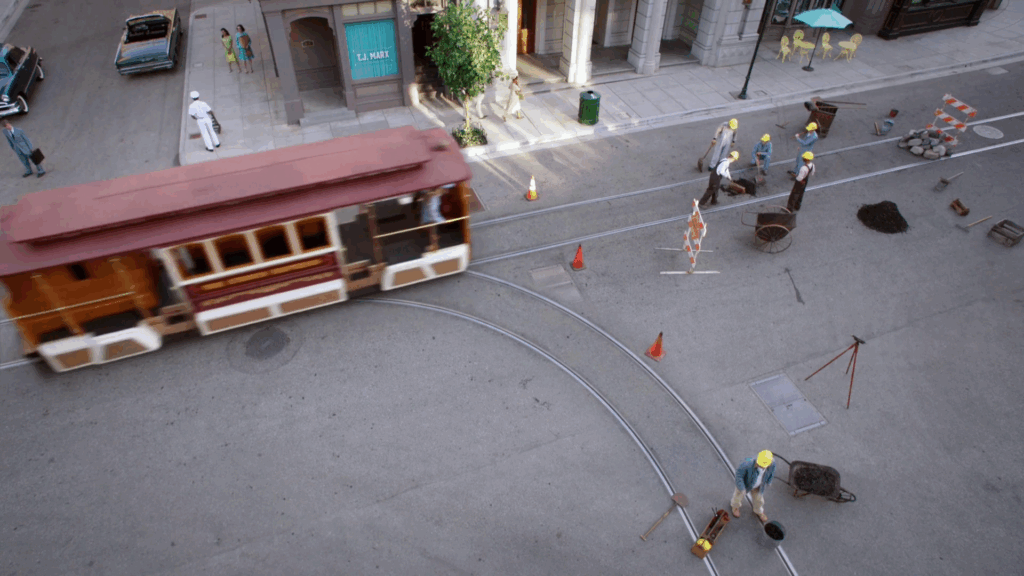
A still from The Good Place 2.06 The Trolley Problem

Chidi, the indecisive moral philosopher, is placed at the controls. He is forced to repeatedly choose whether to kill one or five, and his classic paralysis causes him to freeze, resulting in the death of the five workmen by omission. The trauma is compounded when Michael ups the ante, making the single victim a man Chidi knows, his “boot-buddy” Henry, whose bloody boot (and “guts”) splatter Chidi’s face upon impact.

The brilliance of The Good Place is its tongue-in-cheek thesis that context is catastrophe. The show argues that ethical purity is impossible in the messy, hyper-contingent reality of human life. By the end of the simulation, Chidi is a broken man, realizing that intellectual knowledge of an ethical dilemma does little to steel one’s nerves when faced with the visceral reality of commission. Abstract morality is easy; real morality is a splatter of guts and existential dread.

Love and Heartbreak in the Times of an Apocalypse

But what happens when the trolley problem stops being about a random stranger and becomes about the only person who makes an impossible world bearable?

The climax of the first season of HBO’s ‘The Last of Us’ is, in essence, an inversion of the classic utilitarian dilemma. Joel Miller has shepherded Ellie, a young girl who is immune to the Cordyceps infection, across an apocalyptic America. When they reach the Fireflies’ hospital, he learns the terrible choice: the only way to synthesize a vaccine is to kill Ellie by removing the part of her brain where the immune fungus grows.
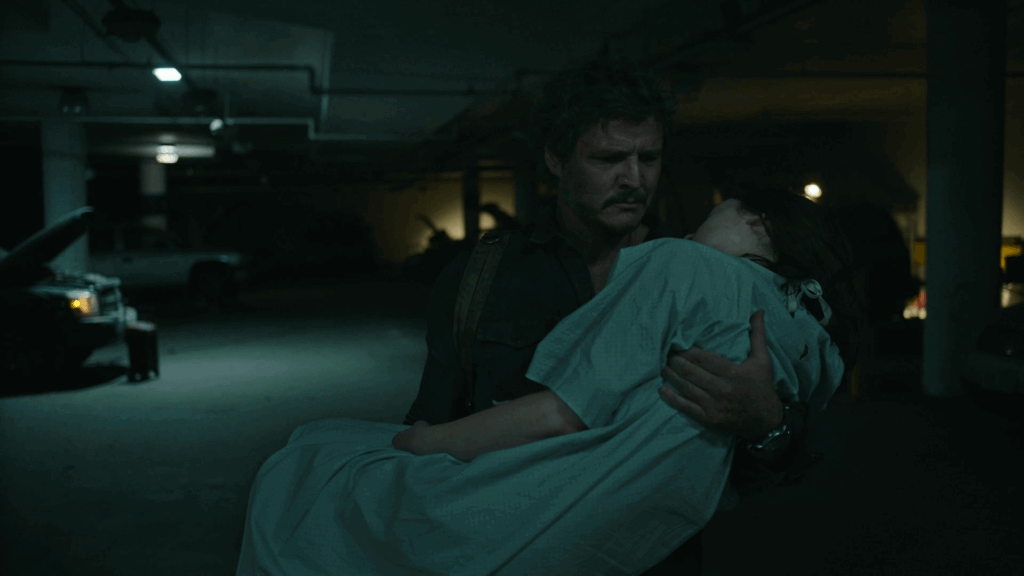
A still from The Last of Us 1.09 Look for the Light

The choice is Utilitarianism’s Triumph (Ellie’s death to save the world/the many) versus Personal Deontology’s Defiance (Ellie’s life, protected by Joel’s violence, dooming the world/the many).

Joel’s decision is the ultimate anti-trolley problem. He doesn’t merely refuse to pull the lever; he pulls the emergency brake, sets the entire train on fire, and murders the conductor (and a few dozen track workers) to save the one. He chooses the individual love he has found over the abstract duty to save humanity. It is an affirmation that for a human being, especially one consumed by grief and attachment, morality is not a simple equation. It is a messy, deeply selfish, and human choice.

They Are Studying This Concept for What Now?

The most bizarre, and yet most real, application of the Trolley Problem today has moved from the philosophy seminar to the engineering lab: How do we program a driverless car (AV) to handle an unavoidable accident?.

Should the car be programmed to be a utilitarian hero, swerving to save a busload of schoolchildren at the expense of its lone passenger (you)? Or should it be loyal to its owner, protecting the passenger at all costs (including the school bus)? For a delicious come-aliving of this dilemma, read Shehan Karunatilaka’s story, A Self-Driving Car’s Thoughts As It Crashes, collected in The Birth Lottery and Other Stories (pub. 2022).
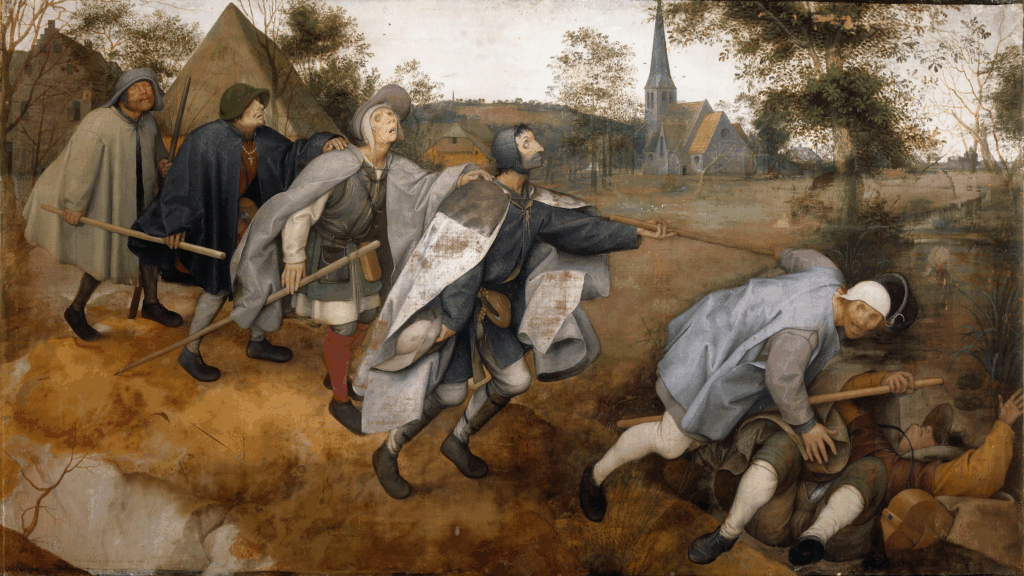
The Parable of the Blind by Pieter Brueghel (1568)

This is a dilemma so immediate that policymakers have weighed in. The German Ethics Commission for Automated and Connected Driving, for example, has declared that autonomous systems should not be allowed to distinguish between people based on personal characteristics such as age, gender, or profession when making an unavoidable collision decision. The car, they seem to argue, must be ethically blind, which effectively rules out the very possibility of the utilitarian calculus that defines the problem.

However, the industry itself often dismisses the entire exercise as a “misguided dilemma”. They argue that AVs, unlike runaway trolleys, are designed to drive so safely that an unavoidable, split-second, five-versus-one catastrophe is a statistical near-impossibility. The real ethical concerns are far more mundane, yet insidious: Who is liable for an accident? And how do we build the system’s “social contract” with human drivers?

In the Eye of the Hurricane

So, after all this deliberation, after the trolley, the fat man, the comedy, the apocalypse, and the autonomous vehicle, do we have a solution?

No. And that, dear reader, is the magnificent point.

The great value of the Trolley Problem is not in finding a universally acceptable answer. Most philosophers indeed agree that one doesn’t exist. Its value lies in the “Exercise in Moral & Legal Reasoning” it facilitates. The problem forces us to articulate our reasons, test our principles against different cases, and observe how a slight change in circumstance—from flipping a lever to pushing a man—upends the entire moral framework.

The ultimate conclusion of Trolleyology is that human morality is not a monolithic theorem but a tension between competing, powerful urges: the logical urge to save the many and the human, emotional urge to avoid causing direct, personal harm. In the end, the question is maybe not what you would do, but why you would do it.

And until the day an AI solves the conundrum to the satisfaction of both Immanuel Kant and a grieving father in a post-apocalyptic wasteland, the trolley will keep rattling down the track, forever testing the structural integrity of our ethics, one scrumptious, horrific scenario at a time.

References:
[1.1] A little twist that puts the so-called “trolley problem” in perspective: r/TheLastOfUs2. (2023). https://www.reddit.com/r/TheLastOfUs2/comments/15e69ti/a_little_twist_that_puts_the_socalled_trolley/

[1.2] Morals of TLOU and The Trolley Problem: r/TheLastOfUs2. (2023). https://www.reddit.com/r/TheLastOfUs2/comments/112iiyl/morals_of_tlou_and_the_trolley_problem/

[1.4] Much like 10 years ago, some people arguing the ending always miss the point: The Last of Us is one big trolley problem, and you can’t invent a third option to get away from it.: r/thelastofus. (2023). https://www.reddit.com/r/thelastofus/comments/11qno3j/much_like_10_years_ago_some_people_arguing_the/

[1.5] The Last of Us and The Trolley Problem. (2025). https://www.youtube.com/watch?v=jHx5u8KiAEM

[2.1] Trolley problem – Wikipedia. https://en.wikipedia.org/wiki/Trolley_problem

[2.2] Could There Be A Solution To The Trolley Problem? | Issue 116 – Philosophy Now. (2016). https://philosophynow.org/issues/116/Could_There_Be_A_Solution_To_The_Trolley_Problem

[2.3] Medical ethics and the trolley Problem – PMC – PubMed Central. (2019). https://pmc.ncbi.nlm.nih.gov/articles/PMC6642460/

[2.4] A Solution to the Trolley Problem | Issue 154 – Philosophy Now. https://philosophynow.org/issues/154/A_Solution_to_the_Trolley_Problem

[2.9] Is there an “accepted” answer in philosophy on the trolley problem? Is this a solved question? : r/askphilosophy. (2023). https://www.reddit.com/r/askphilosophy/comments/18pgugm/is_there_an_accepted_answer_in_philosophy_on_the/

[3.2] Trolley problem | Definition, Variations, Arguments, Solutions, & Facts | Britannica. (2025). https://www.britannica.com/topic/trolley-problem

[3.5] Trolley problem | Research Starters – EBSCO. https://www.ebsco.com/research-starters/religion-and-philosophy/trolley-problem

[1.4] The misguided dilemma of the trolley problem – Volvo Autonomous Solutions. (2024). https://www.volvoautonomoussolutions.com/en-en/news-and-insights/insights/articles/2024/jan/the-misguided-dilemma-of-the-trolley-problem-.html

[1.5] Designing Ethical Self-Driving Cars | Stanford HAI. (2023). https://hai.stanford.edu/news/designing-ethical-self-driving-cars

[1.6] Ethical Considerations of the Trolley Problem in Autonomous Driving: A Philosophical and Technological Analysis – MDPI. (2024). https://www.mdpi.com/2032-6653/15/9/404

[1.8] To Help Autonomous Vehicles Make Moral Decisions, Researchers Ditch the ‘Trolley Problem’ | NC State News. (2023). https://news.ncsu.edu/2023/12/ditching-the-trolley-problem/

[2.2] The Trolley Problem – The Good Place (Season 2, Episode 5) – ‎Apple TV. https://tv.apple.com/us/episode/the-trolley-problem/umc.cmc.602v0v7rfhea6m2jvgsuzbmze?showId=umc.cmc.361pp6dpt0jsmj9sxywuiw665

[2.3] The Good Place Unlocked: Season 2 Episode 6, “The Trolley Problem” – Overthinking It. (2017). https://www.overthinkingit.com/2017/10/23/the-good-place-locked-season-2-episode-6-the-trolley-problem/

[2.4] Chidi wrestles with “The Trolley Problem” on a brilliantly funny The Good Place – AV Club. (2017). https://www.avclub.com/chidi-wrestles-with-the-trolley-problem-on-a-brillian-1819677918

Temptation of Saint Anthony

Did You Seriously Trap a God in Schrödinger’s Box?: A Genre-Hopping Thought Train from Religion to Quantum Physics

Welcome to our annual game night! Today, we sit back, relax, and think about how quantum and existential physics inform our perception of existence and play into the beliefs that shape modern religions by juxtaposing it with an abstract and far-fetched metaphor that will require you to suspend disbelief and possibly adopt an optimistically nihilistic attitude on the absurdity of it all.

Would you care for some Planck fries before we get started? Or maybe a Bohr Slurpee? Surely an Einstein Burger?

Before an age of organized religion that absconds scrutiny on ‘righteous’ grounds dawned on the human race, we have always been curious creatures whom Prometheus carved from his clay. Maybe he forgot to bake into us the knowledge of the true nature of reality, for we have always persisted to traverse beyond the stars, to peel back the jet-black curtain of the cosmos and see who is holding the strings. Because on some level, we feel, that by understanding the nature of our reality and those that shape it, we can be more comfortable with the sweet pleasures and pains of our existence and the undeniable fact that we will all die.

If that is so, believing in something, or someone, makes it easier. It helps us process life in a palatable manner, especially things beyond our control.

Before we commercialized and weaponized our deities, early cavemen worshipped their animals and the earth around them, giving birth to the first animalistic, pagan, and pantheistic beliefs that would later influence religion as we see it today.

But the skeptics have always been there right at the side of the believers.

The Allegory of Faith by Johannes Vermeer (1670–1672)

So how do we know that Gods exist? How do we know that they do not? Some of us rely on our scriptures, while some rely on the concept of energy and entropy. Some think of it spiritually while some do not think about it at all.

Man’s Search for Ultimate Meaning as well as other writings examine the notions of God and existence in relation to each other. Frankl’s conception of existence drops out the deterministic Freudian triad of ego, id, and superego with their attendant conflicts. Frankl goes beyond the deterministic Freudian doctrine of the equilibrium (the homeostasis) of these conflicting elements—at best a fractious psychological armistice—to assert the existence of the unique antecedent which he calls the ‘unconscious God.’

William F. Ryan, The Notion of God

In his book, Ein Psychologe erlebt das Konzentrationslager (“A Psychologist Experiences the Concentration Camp”), translated in English as Man’s Search for Ultimate Meaning, Viktor Frankl says that the deterministic view of observing a human mind as a supreme battle between Freudian principles of ego, id, and superego is reductive. He believes in a deeper guiding force within us that helps us find purpose and meaning in life. This Unconscious God looks at existence from a spiritual level. A far cry from simpler times when we worshipped the rabbit we were about to eat.

We evolved and so did our beliefs. Or maybe we just branched out. Some people feel kinship to their idols while some believe in God and his child come to save us all. There are those who believe in spiritual immortality, proclaiming the balance of birth and death as a transaction of energy within the universe and some just do as their parents tell them to and leave the rumination of existence for the tortured philosophers.

The Cat’s Out of the Box, Baby!

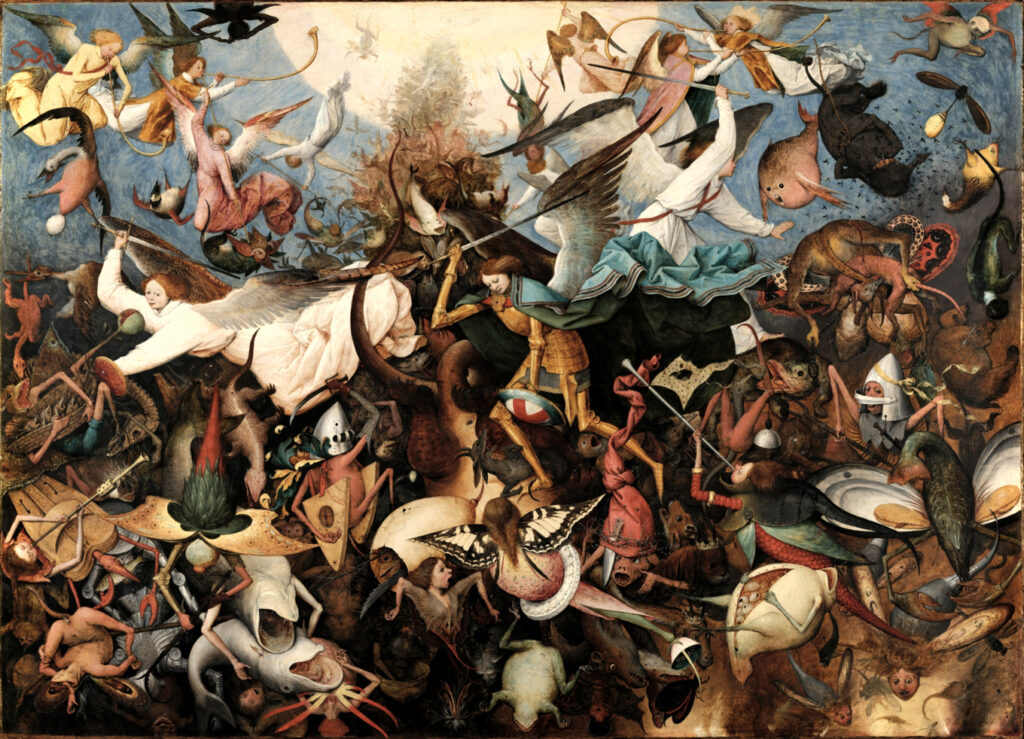
The Fall of the Rebel Angels by Pieter Brueghel the Elder (1562)

Since we are all settled in, we can possibly actually relax now. What is that you hear? Oh no, it’s just Schrödinger’s box. He left it here in my care for he claimed it held hostage- wait for it- God. He said he captured the maker and the destroyer of all worlds within the confines of his wooden box.

I rolled my eyes “God does not exist, Schrödy.

“Are you sure?” he smirked.

“I mean… he could.” I am confused at this point. “No, no. There is no God. But maybe…”

He just smiled. “Don’t wreck your brain. Look, just open the box. You will know! If God exists, you will find them inside. Also, might I add, it is heteronormative of you to assume that the supposed God would be a dude. Do better.”

“Okay, but what happened to the cat?!”

He was already gone by then.

For the unversed, Schrödinger, all the way back in 1935 developed a thought experiment. He had a love for felines and a healthy distrust in the Copenhagen interpretation of quantum mechanics, usually associated with Neils Bohr and Werner Heisenberg (who postulated that a quantum system could exist in a superposition of multiple states until observed, at which point it collapses into one of those states).

Schrödy wondered if that would apply on a macroscopic level: to bigger objects. Simply put, if you put a cat in a box and release a radioactive atom, it could decay or not decay. If it decays, it will release a poison and kill the cat.

Now, until you open the box and make an observation, the cat exists in a superposition: it is both alive and dead simultaneously. I know I know, this is a bit abstract for our less scientifically inclined readers, but bear with me for a moment, for Schrödy has now trapped God.

So? Does God Exist? (Psst, You Might Not Like the Answer)

The Anatomy Lesson of Dr Nicolaes Tulp
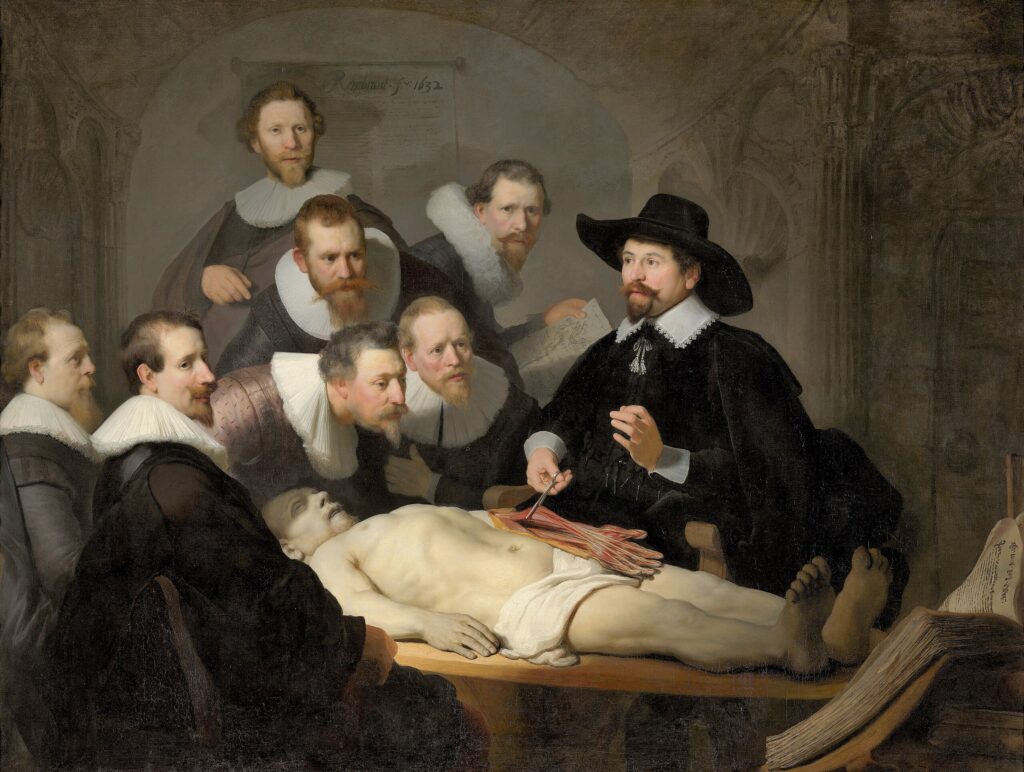
The Anatomy Lesson of Dr Nicolaes Tulp by Rembrandt (1632)

For those of us still on the fence as to where we stand in the grand scheme of the cosmos, while wanting to adhere to principles and dogmas of science that promote inquiry, opening the box Schrödy has left for us might not be the wisest idea. We are a product of our preconceived beliefs, and our life experiences shape us to influence the way we see the world and react to it. Has Schrödy really trapped the God? Does God even exist?

Until we open the box and observe, God exists in a ‘superposed’ state. They are either in the box or they are not.

They exist or they do not.

The act of observation collapses the superposition into a single state. In the context of religion and belief in God, one’s personal beliefs, experiences, and interpretations can also influence their perception of God’s presence or absence. It also evolves our questioning. Do we even want to open the box? What would become of the world if we do know, especially if it is an answer you do not like?

The existence of God and the nature of divinity are deeply complex and subjective questions that transcend the scope of empirical science, and in an extension, this thought experiment. It just serves as an aperitif, a vaguely clouded metaphor reflective of the real-world state, posed just to highlight the complexities in the nature of these inquiries and how (and if) science and faith can shake hands before the coin toss.

Encore

Four Horsemen of the Apocalypse
Four Horsemen of the Apocalypse by Viktor Vasnetsov (1887)

Now that the night has sighed its way away and dawn breaks out from beneath the mountains in gentle, lapping strides, I leave you with this quote from Kierkegaard, one of the most influential thinkers in existentialism, who believed that God comes into the single individual, and that’s where the place of God is. It’s not “out there” somewhere.

I see it all perfectly; there are two possible situations — one can either do this or that. My honest opinion and my friendly advice is this: do it or do not do it — you will regret both.

Soren Kierkegaard, Either/Or: A Fragment of Life

At the end of the day, perhaps a solution is to open Schrödy’s box and if you decide to believe what your eyes see, do so. Make your existence easier.

If not anything else, thought experiments like these prove that there is a way for science and religion to coexist in a begrudging harmony. That they can pave a path forged in inquiry, faith, and most of all tolerance.

Perhaps that is how we discover, and uncover, the greatest secrets of this maddeningly beautiful universe.

Oh, and if you see Schrödy, tell him to take his damn box back.

The Sweet Agony of the Bonkers: Absurdity in Wes Anderson’s Asteroid City

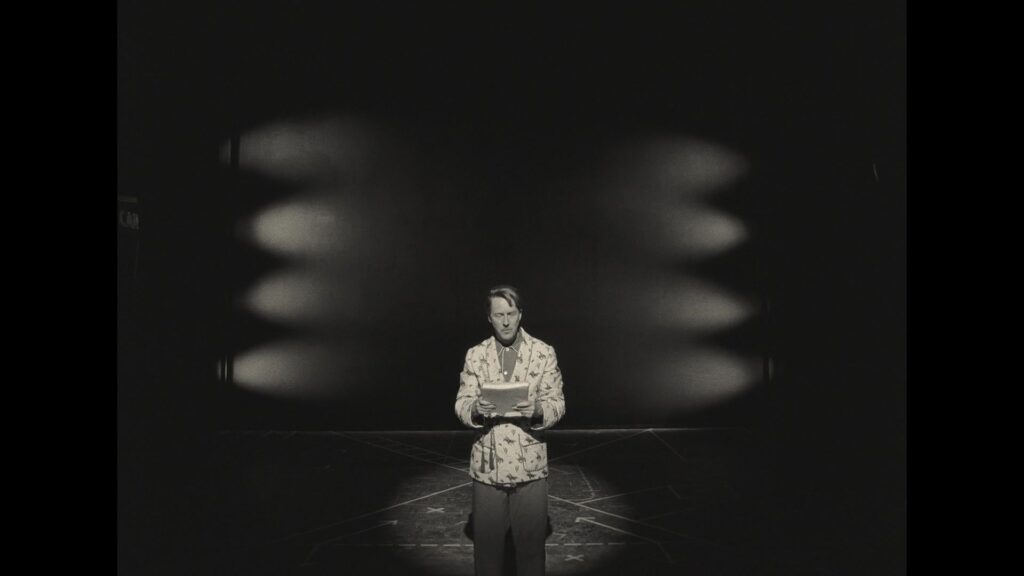
Conrad Earp – Well, Saltzie, the thing is, I’d like to make a scene where all my characters are each gently, privately seduced into the deepest, dreamiest slumber of their lives as a result of their shared experience of a bewildering and bedazzling celestial mystery.

Saltzburg Keitel – A sleeping scene.

Conrad Earp – A scene of sleep.

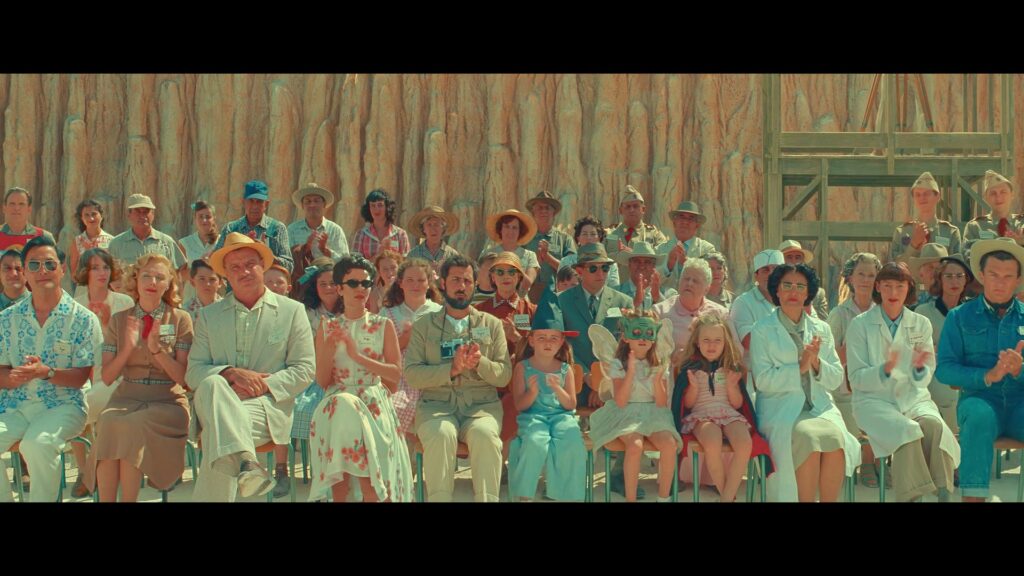
A still from Wes Anderson’s Asteroid City

A scene in Wes Anderson’s Asteroid City sees Edward Norton’s Conrad Earp intone these words in a delicately measured rhythm, which are devoid of external emotion but are surprisingly, usually, profoundly expressive. Of course, it’s something Anderson’s characters are wont to do, in the signature long takes, unflinchingly gaze at the camera, or the audience: their words eloquent, yet deadpan. One can attest that bewilderingly, these words quite sum up what it is like to view this movie.

Asteroid City begins with Bryan Cranston’s narrator setting the scene. The movie we, the audience, see is actually a television special about the making of a modern American theatre production. Here, the actors are playing, well, actors, who themselves act out the segments of the play being produced. One obviously cannot not notice that the actors in real life are playing these aforementioned actors in the movie Asteroid City about a television special about… well, you know the drill.

The main play, which the TV special is about, also called Asteroid City, is set somewhere in the Southern California-Nevada-Arizona desert and focuses on a stargazer convention, where different space cadets and their families are entangled with a young teacher leading a field trip to a bus full of elementary schoolchildren, a quirky motel manager, a singing cowboy, the US military, a socially awkward scientist and in a signature Anderson move, an actual alien.

The Densely Ambitious World of Asteroid City

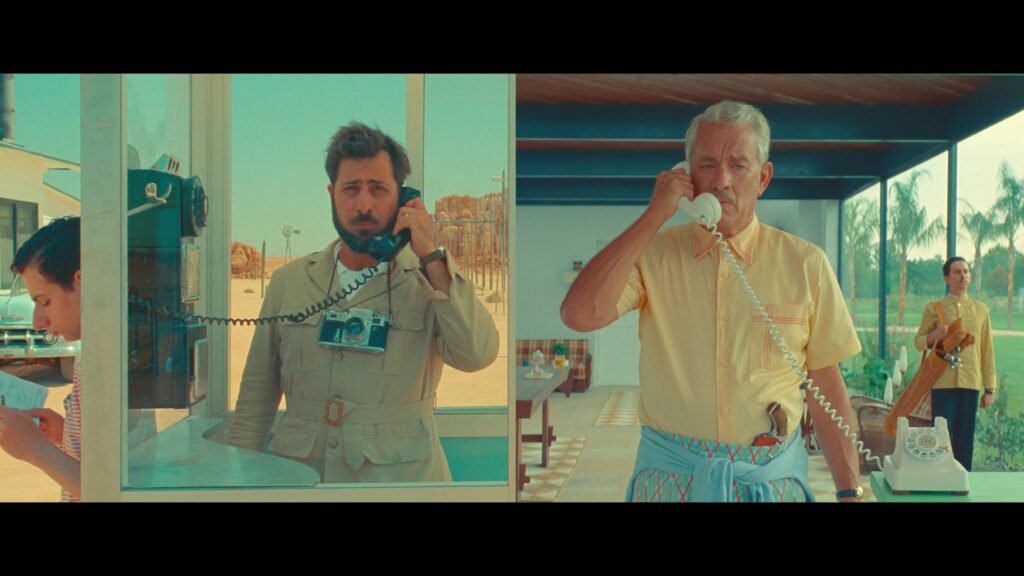
A still from Wes Anderson’s Asteroid City

This might be Anderson’s densest movie yet, not just in terms of the thematic juggernaut of ideas and emotions it can be about or is commenting on, but also in terms of the story and the characters. It’s also widely ambitious.

It is understandable why some viewers may find it less accessible. And yet somehow, it manages to reel you in. You might not even understand what the point of the movie was after all, but you are left with a gratifying sense of completion and an eager desire to come back for another round. From the moment Cranston appears on screen, you are captivated into this incredibly meta, sad, alive, bright, hilarious, zany, very, very Wes Anderson world as if privately seduced into the deepest, dreamiest slumber of your lives.

What is the movie about, then? Is it an exploration of how pandemic affected the society as a whole, or is it a tribute to Western movies and folksy music with a healthy dash of whimsy and sci-fi thrown in? Is it about moving on after the death of a loved one or is it about shared experiences with strangers leading you to a transformative journey?

Perhaps it is a satire on the space exploration frenzy and the American obsession with UFOs in the postwar 20th century, or perhaps it is a retrofuturistic story of lost souls in this universe trying to make sense of the experience of what it is to live or find meaning on a random floating piece of rock in the space when there appears to be none. It could very well be a love letter for the performing arts and the sweet labor that goes into it by those who create art, and then find ways to process and celebrate their experiences of existence as well as their trauma and joys and tribulations in life through their art.

Asteroid City could be about all of these or none. But what it is, for certain, is cinematic. It is not inaccessible, you just have to let your guard down and let yourself be swept into the slumber.

Augie Steenbeck and Existential Reflections

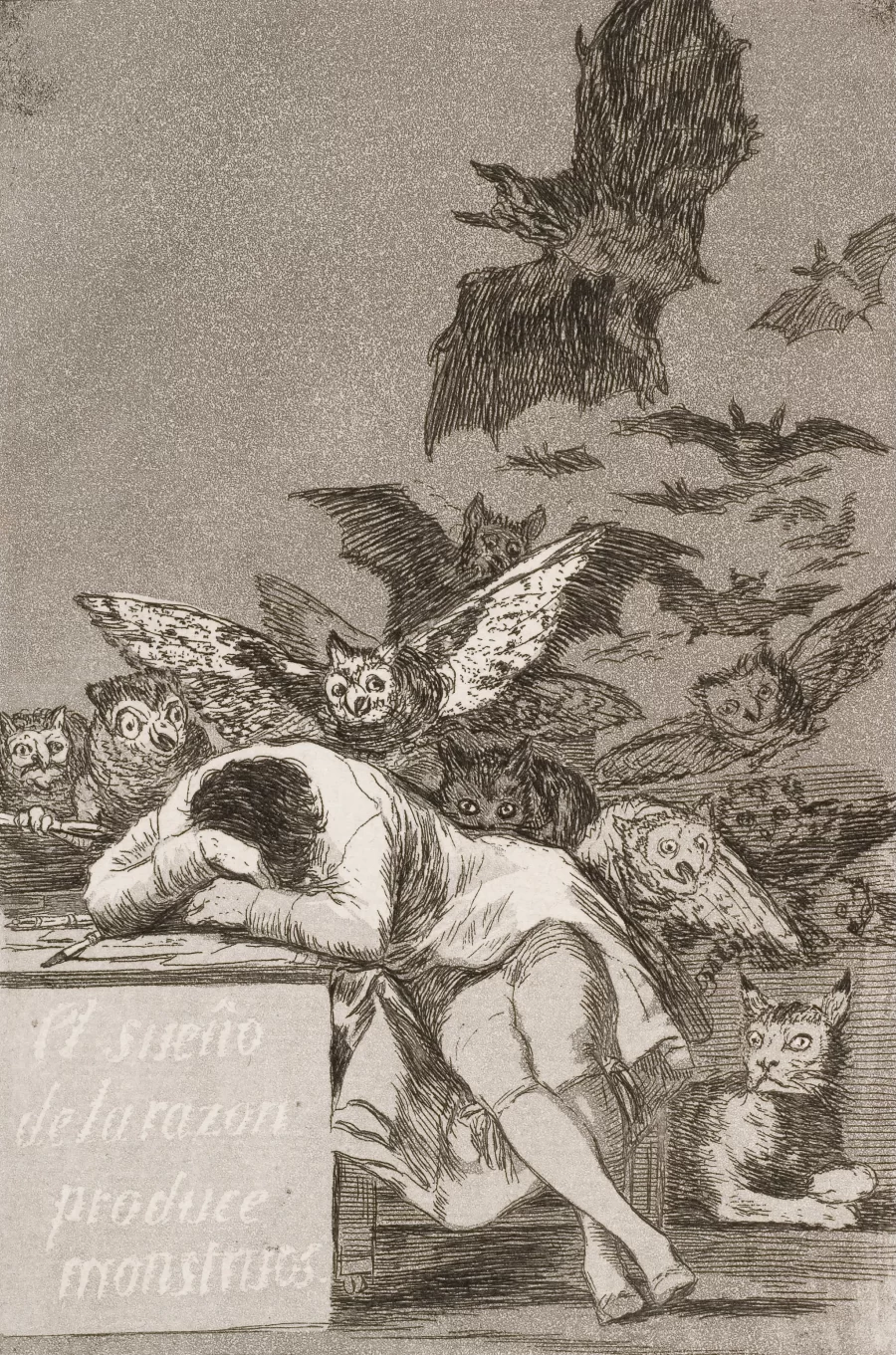
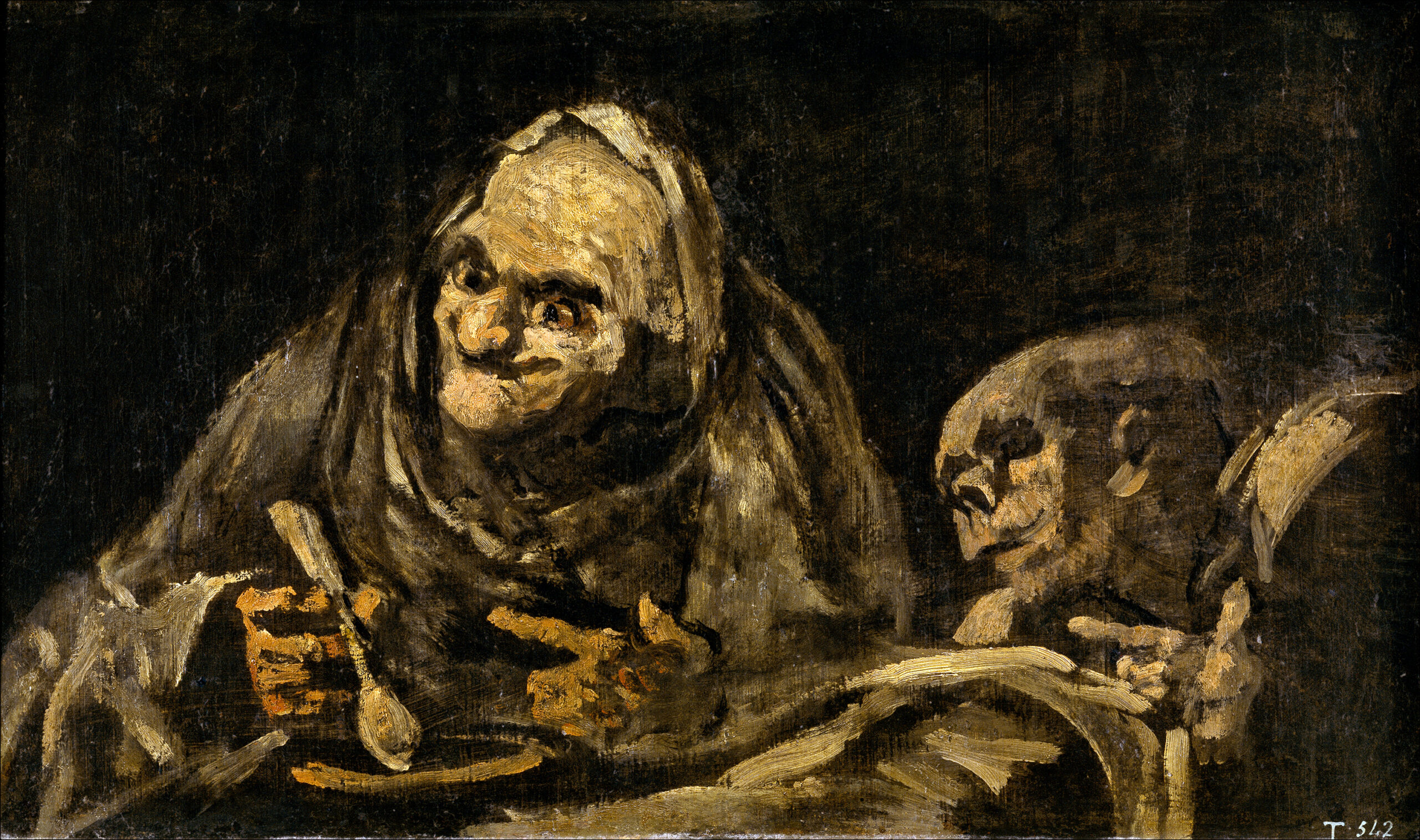
Dos viejos comiendo sopa by Francisco Goya

Augie Steenbeck: I still don’t understand the play.

Schubert Green: Doesn’t matter. Just keep telling the story.

Asteroid City in its very nature is profound and existential, or that is one way to interpret it. Jason Schwartzman’s gut-wrenchingly sincere portrayal of war photojournalist Augie Steenbeck is one of the many clear highlights in this movie. He’s also playing Jones Hall, the actor playing Steenbeck. Both roles have a common concordant theme: they are learning to cope with the loss of a loved one. His conversation with the director of the play, Schubert Green (played by the Anderson staple, Adrien Brody), about not understanding the play could just as easily be an allegory to a person mourning and struggling to live after an incidence of profound grief, as it could be about an actor attempting to make sense of complex emotions in his life through his art.

Another scene with Steenbeck involves a conversation with the cynical and depressed actress Midge Campbell (played by a marvelous Scarlett Johansson) about how he felt the alien looked at them as if they were doomed, to which she replies, “Maybe we are.”, could be about being comfortable with the fact that life may have no meaning as easily as it could also be about where her character is in terms of her personal journey. The takeaway is that Anderson doesn’t give any answers. It is on the viewers to interpret as they wish, and that is the beauty and frustration of Asteroid City. After all, we as viewers are playing multiple roles too.

We are watching the movie wherever we are watching it (a movie theatre, or on our laptops, tablets, or phones). We are also the viewers of the television special and the play the television special is about. Talk about breaking the non-existent fourth wall.

The Andersonian Touch

A still from Wes Anderson’s Asteroid City

The signature Wes Anderson stamp is etched delightfully on the very fabric of this movie. The eccentric ensemble (filled with Anderson alums Jeffrey Wright, Tilda Swinton, Adrien Brody, Edward Norton, and a noticeably absent Bill Murray who could not participate in the filming due to a COVID infection and was replaced by an effusive Steve Carell), wide and satisfying camera angles, bright colors and an impeccable attention to detail, a Jarvis Cocker song (and a cameo too!), romance, precocious teenagers, world-weary adults, rock and folksy country and western music, prosaic and repetitive dialogue, panning shots of landscape and the characters, an overpowering sense of whimsy, all of it is packed symmetrically in this movie.

Anderson first-timers Scarlett Johansson, Tom Hanks, Steve Carrell, and Margot Robbie are given significant parts to toy around, with the latter appearing in just a single scene of massive thematic importance. A more challenging story on paper, the heartfelt acting, fantastic musical score, and beautiful vistas and visuals help penetrate the dense tapestry that makes this movie what it is and grounds it.

The Simple Complexity of Grief

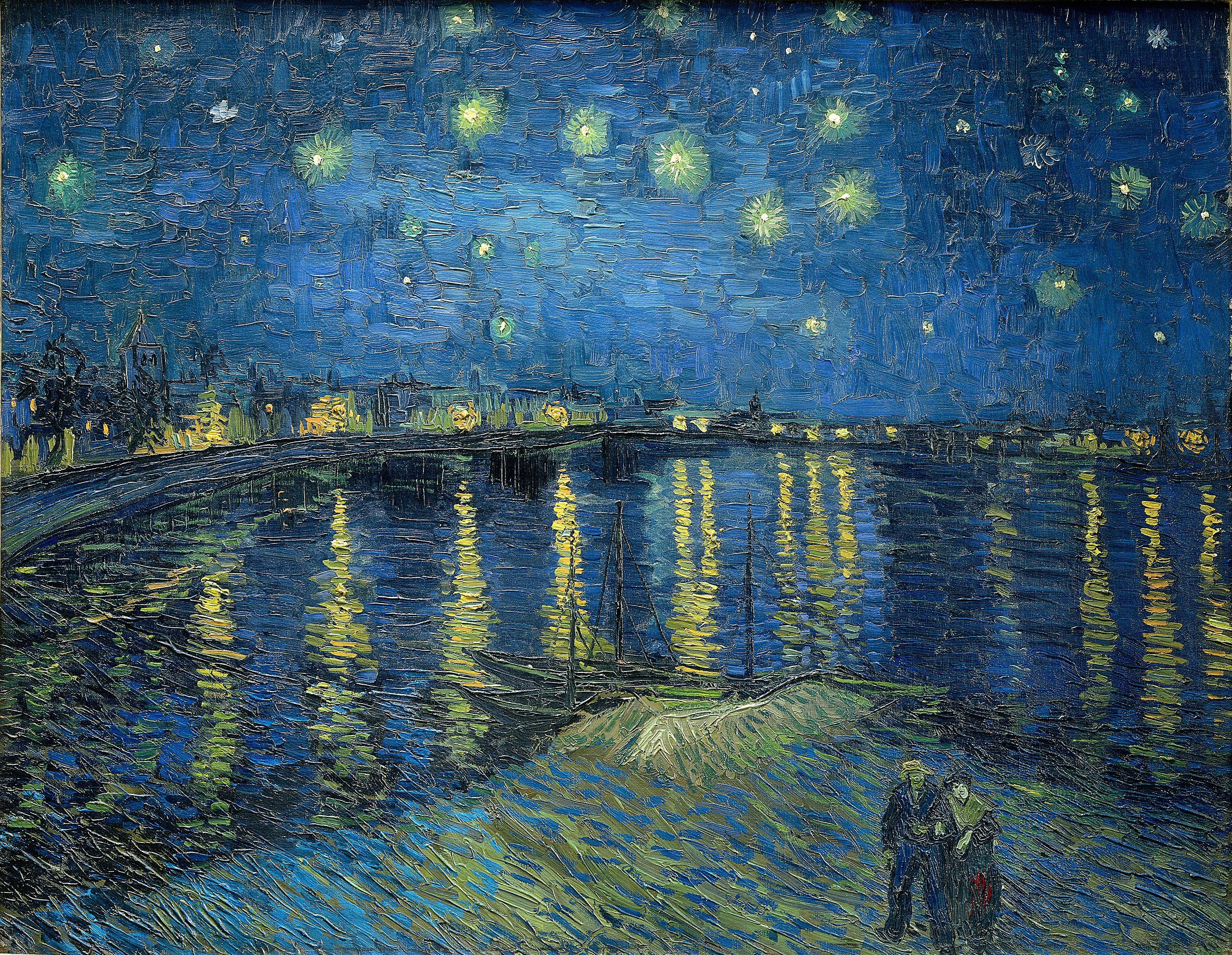
Starry Night Over the Rhône by Vincent van Gogh

Augie Steenback: When my father died, my mother told me, “He’s in the stars.” I told her, “The closest star, other than that one, is four and half light-years away with a surface temperature over 5,000 degrees centigrade.”

“He’s not in the stars,” I said. “He’s in the ground.”

She thought it would comfort me. She was an atheist.

One of the biggest takeaways from this movie for me was the utter simplicity of the message in one of the strangest sequences of the movie: the entire cast chanting “You can’t wake up if you don’t fall asleep.” in unison to the audience. As with any life experience, but particularly with processing grief, Augie says that “Time is maybe like a bandaid.”

It doesn’t heal your wounds, just covers them. Instead of numbing yourself to the overpowering woe of grief, one has to allow themselves to live through it. To feel whatever emotions the loss brings, in any way it does. Augie learns to do that in his own way both in and out of the play. One cannot overcome grief without having embraced it first. One cannot wake up until they fall asleep.

Wes Anderson is slowly cementing himself as one of the most prolific filmmakers and auteurs of this century, with his prolific style and a pedigree of genuine whimsical movies. While not as straightforward as The Grand Budapest Hotel, his latest entry in the form of a very existential and moving tribute to grief, southwestern America, extraterrestrials, and the very nature of art, Asteroid City is more than a worthy addition to his playbook of stylistic romps.

Asteroid City is for the outcast and the nerds, for anyone who feels like they could feel more at home outside Earth’s atmosphere. It is for the actors and the stage grips and the tech crew as much as it is for cowboys, conspiracy theorists, inventors, real estate investors, and believers in UFOs. It is for all those who fear that if they don’t make a sound, nobody will know they exist. It is for people in and out of love, and for those who have lost someone they loved.

The delicious absurdity in Asteroid City is in a way, quite like life. You do not understand all of it, but you enjoy it nevertheless. Or at least learn to.

Las Meninas by Diego Velazquez

Shattering the Fourth Wall – The Flair of the Self-Aware

Long before Phoebe Waller-Bridge looked awkwardly into the camera and won the hearts of even the most stone-cold viewer and critics alike with her perpetually messy life as Fleabag, our article opens with a panning view of a house in the suburbs in the earlier years of this century. It is a rosy morning and our camera pans through the idyllic street gently littered with orange autumnal leaves, to the window that offers a glimpse into the life of a normal family, blissfully unaware of the voyeuristic eyes of hundreds of viewers picturing them in their heads through the screen of whatever device they are reading this article in.  

Inside the house, a child sits in front of her TV set and claps her hands when a familiar figure in the now-iconic pink T-shirt, orange shorts, and a splashy purple backpack grins through the screen of the vintage television set. Her friend is an intelligent simian creature named after human footwear. “We had such an exciting trip today! What was your favourite part of the trip?” The valiant Dora the Explorer asks the little girl watching her adventures. “The lava mountain! The lava mountain!” The child shrieks in joy.

Her brother is a comic book aficionado and is sitting in the adjoining room reading The Sensational She-Hulk #1 which came out way back in 1989. He usually reads the adventures of Professor Charles Xaviers and his merry band of mutants, but he is partial to Jennifer Walters. The superheroine is flexing on her comic, flaunting her perfect hair while threatening the X-Men readers to finally give her story a shot. “Okay. This is your second chance. If you don’t buy my book this time, I’m gonna come to your house and rip up all your X-Men.” She grins. What can I say? She has a reputation for talking with her audiences. 

Hey! See what I did there? I’m talking to you now. That’s cool, huh? Enough of being a peeping Tom to these poor kids. Let’s take a stroll in times of yonder. Yes, even before Matthew Broderick’s dashing turn in Ferris Bueller, or Mary Maclane’s 1918 movie ‘Men Who Made Love to Me’ where they address the audience directly. Roll the camera. 

Let’s go all the way back to when stage plays and performing arts was the new cool. Let us imagine that stage, shall we? We know it has three walls, well sort of, as performers elicit the widest range of emotions ever conceivable in front of a live audience. There is a fourth wall too. It separates the performers from those watching them, completing a bubble of sorts, and in its entirety, completing the illusion that we buy into. Denis Diderot, a prominent figure in ‘The Age of Enlightenment’ is said to have conceived this wall, advocating its existence: With a fourth wall, performers can more closely imitate reality. 

Denis Diderot by Louis-Michel van Loo (1767)

Every once in a while though, a character will address the audience directly, displaying a surprising sense of self-awareness. As if they know that the reality they are in is not real. That it exists for the purpose of entertainment or for creating meaningful art. It’s an illusion, suspension of disbelief, that the assemblage and the performers are collectively buying into. Media in general. So when a character chooses not to, we call that ‘Breaking the Fourth Wall’. The simulacrum of the conceived barrier separating realities is shattered. It’s a tongue-in-cheek metaphor, I know, but the brilliance of this tool in the performing media, and now on celluloid and TVs exhibit exceptional savoir-faire. 

It is not only a demarcator of the emergence of a renaissance in the naturalistic theatre, but it is also a break from dramatic conventions that dictate buying into the fake reality of the performance. While some may argue that the fourth wall did not even exist for the staging of the Bard of Avon’s plays, what with William Shakespeare’s love for soliloquies and monologues being directly spoken to the viewers, the art of breaking the fourth wall has expanded since and continues to do so. From comics to mockumentary-style television to video games to Ryan George’s hilarious Pitch Meetings on Youtube, it is a savvy tool used deftly by artists and creatives alike.

Some use it as a tool of comic effect, while some use it to make their characters more complex and dynamic. Some use it as a window into the world a character may inhabit, and to explain their motivation, while it has also been used to elicit sympathy or other emotions for a situation or a character. Alvy Singer, played with heart-breaking sincerity by Woody Allen in the brilliant movie ‘Annie Hall’ (1977) breaks the fourth wall several times. Allen said of that, “because I felt many of the people in the audience had the same feelings and the same problems. I wanted to talk to them directly and confront them.” He managed to comfort us as well while at that.

Woody Allen in Annie Hall (1977)

My editor reminds me to mention that this technique exists in literature too! It’s called Metalepsis, the writer’s version of going meta. Be it John Fowles’ utterly brilliant “The French Lieutenant’s Woman”, Lemony Snicket’s well, everything (Dear Reader, there are people in the world who know no misery and woe…), or the deliciously ergodic and auto-referential, genre-hopping, paranoid masterpiece of Mark Danielewski, ‘House of Leaves’, metalepsis itself, its influences in post-modern and experimental literature have been phenomenal. 

Not to mention, ever since She-Hulk literally broke the fourth wall in her comics to have a word with her editor (something replicated unfortunately poorly in her MCU show), others started doing it too, most well-known among them being everyone’s favourite Merc-with-a-mouth, Deadpool. It is worth mentioning that characters like Dr. Fate, Squirrel Girl, Loki, and even Superman have been known to do the same in the comics on occasion.

Oh wait, I’m receiving some last-minute notes. Looks like that’s all the time we have today, folks! Imagine me winking through a loop of concentric circles, Looney Tunes style. Breaking the Fourth wall is a brilliant technique when used smartly, even sublime. So when the next time a character smiles at you through the camera, maybe smile back at them? Let them know you’re in on the secret.

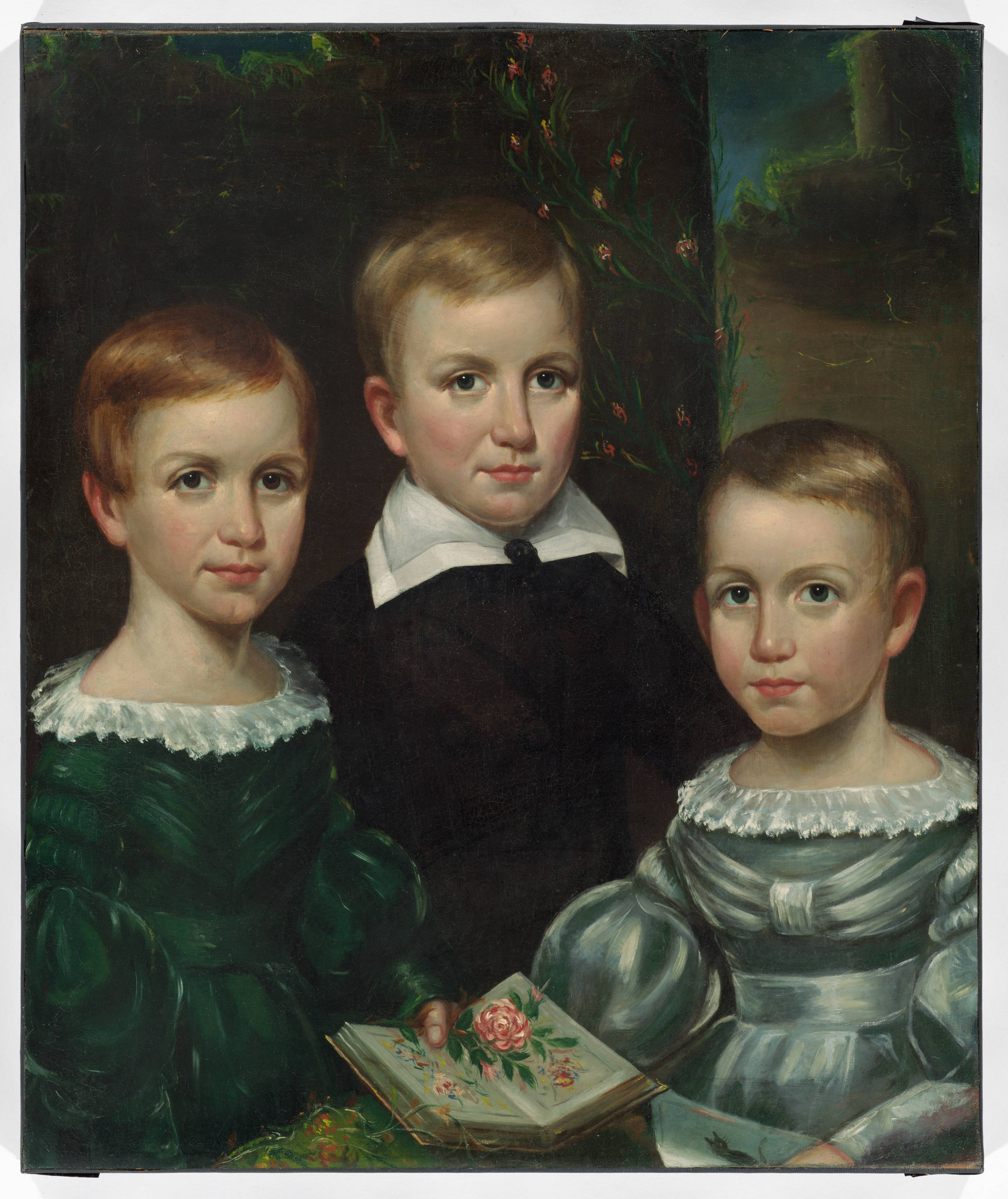
Lavinia Dickinson

You Can Not Put a Fire Out– I, Emily Dickinson’s Little Sister

This piece is the second in a series of articles examining Emily Dickinson’s life, work, legacy, and enduring significance in poetry and popular culture. Read the first part here.

Lavinia Norcross Dickinson, or Vinnie, as she was fondly called, lived most of her life in the Dickinson Homestead in Amherst, Massachusetts, where she was born. Beautiful, loyal, curious, and vivacious, she devoted her time to housework and keeping the machine going. Of her, her niece, Martha Dickinson once wrote: “Upon her, very early, depended the real solidarity of the family”.

She had to, especially when her mother succumbed to grief after her father passed away in 1874. She never wed, and after her mother too had passed, she took care of her sister, Emily, a recluse who would one day make a name for herself in the world and leave behind a rich and enduring legacy of the Dickinson name.

Vinnie’s sister would one day rise up to become one of the most celebrated poets and one of the most exceptional minds of English literature. Emily Dickinson would one day take over the world with her words, even though she would not herself be around to see it. But it is a little-known fact, that the genius of Emily Dickinson might have not seen the light of day when it did, or at all, had it not been for sweet Vinnie.

An Extraordinary Poet & (not) a Recluse

While Vinnie devotedly cooked and cleaned and kept the Homestead in order, her older sister Emily sat at her desk in her room and scribbled furiously as ideas poured out of her head in the form of exquisite poetry. While many misconstrue her as The Woman in White or a lonely woman, she had lived a full life.

She had correspondences with writers and poets, and a network of friends and family who supported her and loved her. She shared a special love with her sister-in-law, Susan Gilbert, wife to Austin Dickinson, who lived in the neighboring house, the Evergreens.

In one of her letters, she writes, 

To own a Susan of my own

Is of itself a Bliss – 

Whatever Realm I forfeit, Lord,

Continue me in this!

Emily wrote even when her eyes became weak and even when poor health grappled her sweet soul. Living a blissful solitary existence in her homestead, Emily wrote and she wrote until her fingers burned. In her last few years, she would rarely go out. Beset with a great number of personal tragedies and losses, and in helping Vinnie share the load of housework, her writing seemed to get more disorganized and frantic. She no longer collated her poetry in her booklets. She wrote on bits of paper, and she wrote on scraps, in a haste unlike any. She wrote until her health failed.

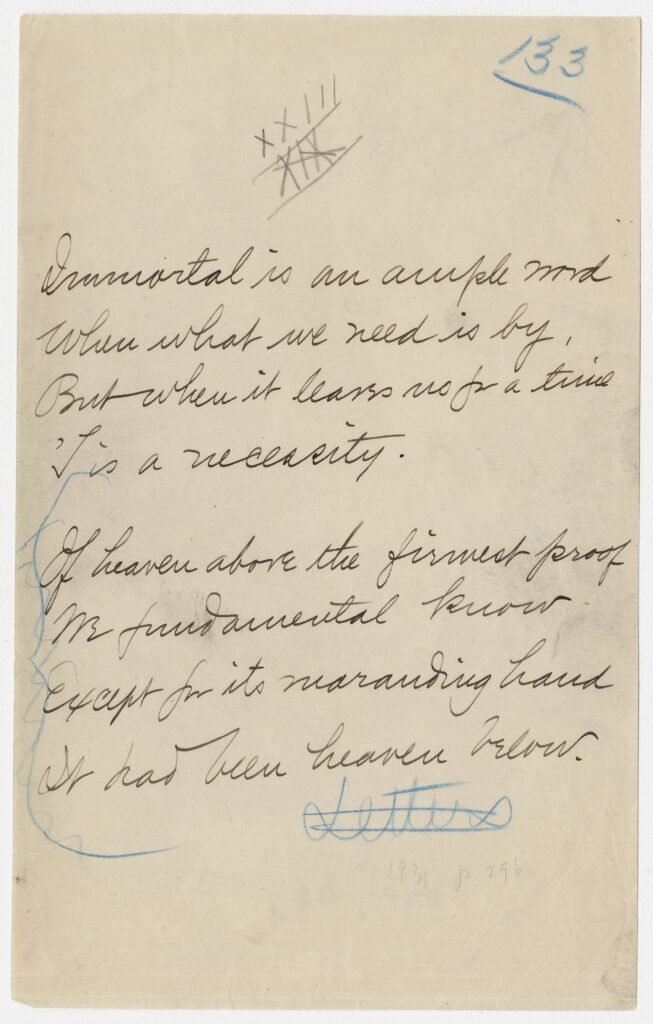
Emily Dickinson Poem
Transcription of Emily Dickinson’s “Immortal is an ample word” (1886-96)

Before passing in the May of 1886 after more than two years of ill health, she requested Vinnie to burn her letters and correspondences.

The Chance Discovery of a Genius

Vinnie stood alone in the home she had known all her life, all alone, grieving for the loss of her sister who she had loved and protected all her life. She burned the letters and tried to make sense of the acute loss she had suffered in recent years. That is when she found them.

Now, Emily had been published before, anonymously and not, but not much of her work had reached beyond a certain few circles. Vinnie found hundreds of her sister’s poems, most of which were not read by eyes any other than Emily’s own. Her late sister had left no instructions as to what fate she wished for her words.

Vinnie took a decision. Her sister’s words would be published. The sheer brilliance of her work deserved its chance in the sun. Vinnie loved her sister. Within the next few years, Vinnie made all efforts conceivable to publish Emily’s work. She wasted no time in collecting her works and making sense of hundreds of scraps of paper her sister had left behind. She wrote to Thomas Wentworth Higginson, a revolutionary abolitionist, writer, and women’s rights movement supporter, Emily’s dear friend, frequent correspondent, and one of her staunchest supporters, in 1890: “I have had a ‘Joan of Arc’ feeling about Emilies poems from the first.”

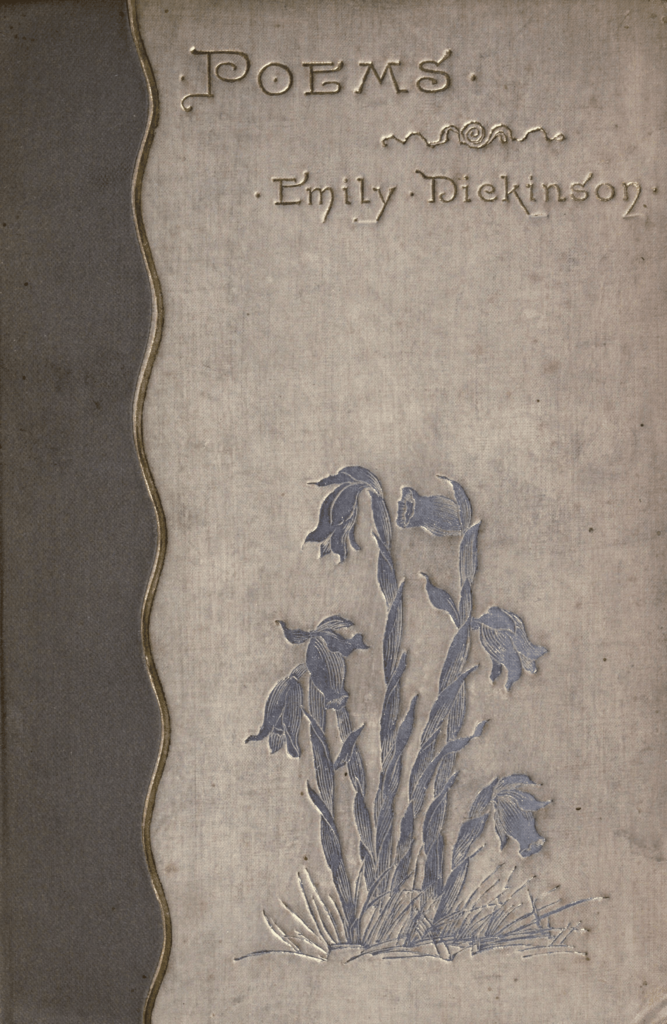
Due to her efforts, Higginson, who co-edited the first publication, and Mabel Loomis Todd, wife of an Amherst College professor and a celebrated artist, Poems of Emily Dickinson (the first series) was put to print in 1890, four years after the author had passed away.

Poems by Emily Dickinson
Poetry by Emily Dickinson (1890)

Vinnie’s chest swelled with pride and she stood with her brother and Susan, her nephew and nieces, and Higginson and Todd. Poems though, did not even collect a small fraction of the material Emily had written over her lifetime. There was much work to be done. All of Dickinson’s work would not be collated until 1955, several editions later, when Thomas H. Johnson, a literary scholar would compile it all and edit the original manuscripts to publish The Poems of Emily Dickinson long after Vinnie and Higginson and Todd had all passed away. For now, tears streamed out of Vinnie’s determined eyes and she sat on the bed her sister slept on in the room her sister never left with a copy of Poems in her hand. This wasn’t the beginning, but it was a beginning. Emily Dickinson was well known enough in the town of Amherst, but soon, the entire world would know her sister’s name.

You Left Me, Sire: Two Legacies- A Feather Falls on Emily Dickinson’s Grave

This piece is the first in a series of articles examining Emily Dickinson’s life, work, legacy, and enduring significance in poetry and popular culture. Read the next part here.

Emily Dickinson thought of death quite a bit. She wrote of it extensively too, with poems like “Because I could not stop for Death”, “I felt a funeral in my brain”, and “A coffin is a small domain”. Her words are punctuated by short phrases, idiosyncratic vocabulary, metaleptic punctuation, and vivid imagery, and her work is transcendental, of immense wit and intellect, capturing the zeitgeist of being a woman in the nineteenth century. Despite her ruminations on god, the nature of immortality and death, and ponderings on spirit and mind, she wrote with a refreshing verve and insight. Her words are a source of comfort today.

1.

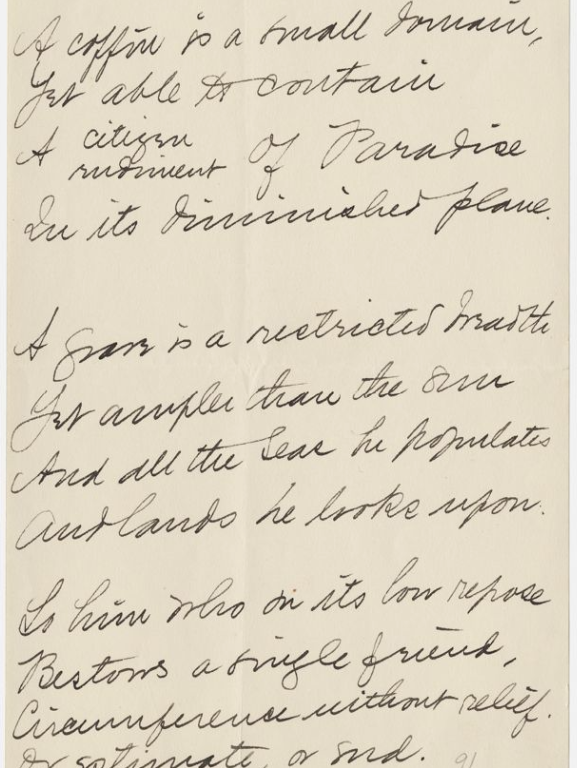
Transcription of Emily Dickinson’s “A coffin is a small domain” (1886-96)

“A Coffin — is a small Domain,
Yet able to contain
A Citizen of Paradise
In it diminished Plane.”

The trees of the West Cemetery in Amherst, Massachusetts sigh languidly on a lazy summer day as a gust of wind blows through their leaves. A feather rode the tides of the wind and swam through the air. The summertime haze lifted in the cemetery on Triangle Street and quickly, the feather frolicked its way through the gravestones and the trees. The day was strangely alive and the cemetery was occupied by a bunch of visitors across the 4-acre plot.

An iron fence separates some graves from the rest around which a throng of people stood. Miraculously, the feather swam above their heads, and just as sudden as the gust that had lifted it up originally, the wind died. The feather fell with a soft moan near the marble slab that was cool to touch in the balmy breeze, soft like a kiss. On it was engraved: “Emily Dickinson. Dec. 10, 1830. Called Back. May 15, 1886.”

The ground has memories, the soil remembers. May 19, 1886. It remembers the small funeral procession in the Dickinson Homestead. It remembers how the procession started at the parlor of the Homestead, then circled the poet’s flower garden and as per her own instructions, went through the house barn and through a grassy path lined with buttercups to the cemetery on Triangle Street. It remembers the beautiful white coffin and it remembers a grave lined with evergreen boughs laid by a loving heart and a trembling hand by Susan Gilbert Dickinson.

Emily Dickinson had breathed her last.

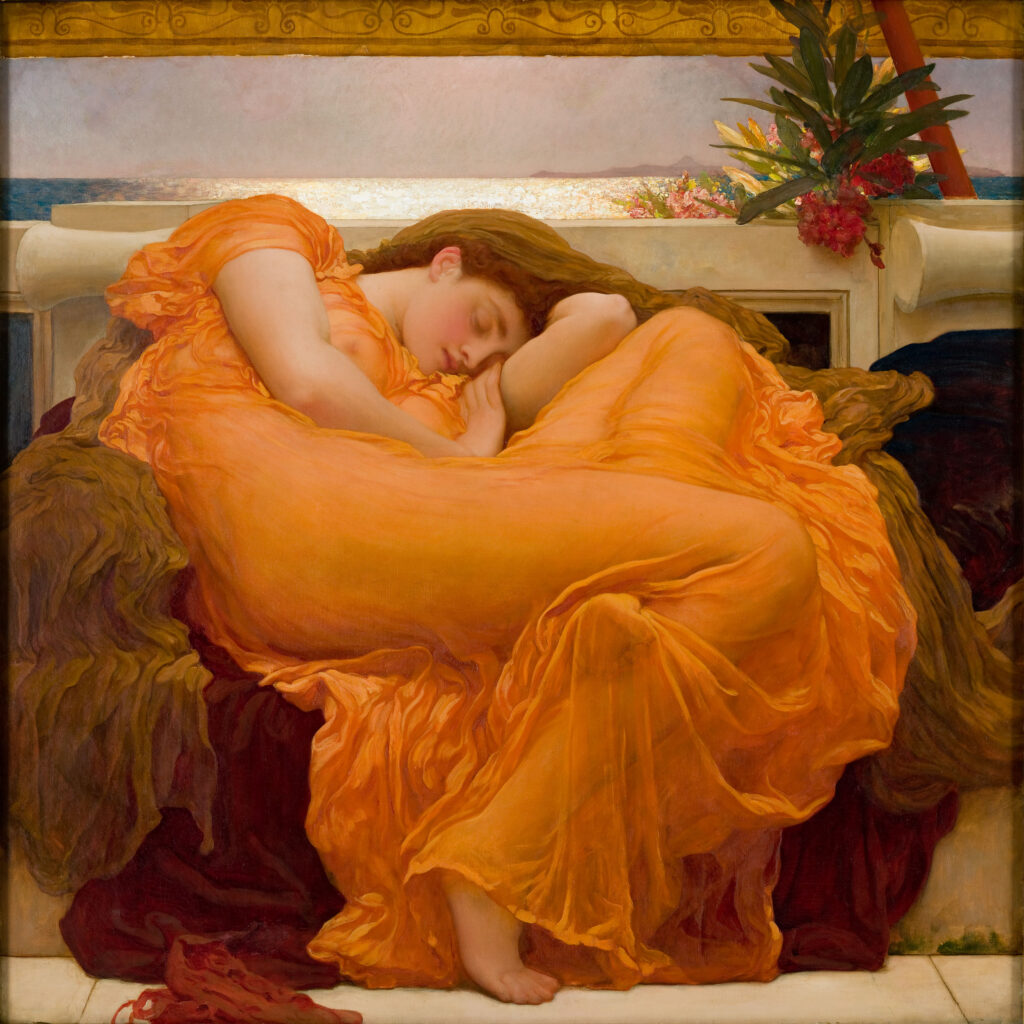
Flaming June by Frederic Lord Leighton (1895)

A small, yet intimate gallery of personas had gathered, who had loved this woman or seen her grow up. Austin and Susan Dickinson, her brother and sister-in-law held each other in their arms and watched her being lowered into the grave to begin the next great journey of existence. Susan would later write her obituary in The Springfield Republican, “A Damascus blade gleaming and glancing in the sun was her wit. Her swift poetic rapture was like the long glistening note of a bird one hears in the June woods at high noon, but can never see”.

2.

“A Grave — is a restricted Breadth —
Yet ampler than the Sun —
And all the Seas He populates
And Lands He looks upon”

Lavinia Dickinson, the youngest sibling, sat upright beside them, shaking. She had no inkling of the idea that she would find a vault of thousands of poems by her late sister later. Thomas Wentworth Higginson, Emily’s close friend and a fierce champion of her poetry was somber. He could not get the face of his friend out of his mind, sneaking a glance before they closed the coffin. He had read Emily Bronte’s poem, “No Coward Soul is Mine” at the service and smiled when he saw her lay peacefully in white clothes as if she slept.

He remembered the first words he ever read from her in a letter, “MR. HIGGINSON, — Are you too deeply occupied to say if my verse is alive?” It felt like that had been ages ago. He would later write, “E.D.’s face a wondrous restoration of youth – she is 54 [55] & looked 30, not a gray hair or wrinkle, & perfect peace on the beautiful brow. There was a little bunch of violets at the neck & one pink cypripedium; the sister Vinnie put in two heliotropes by her hand ‘to take to Judge Lord’.”

After Emily Dickinson was lowered into her eternal resting place in the earth’s loving embrace, a gravestone was erected with her initials, E.E.D. Years later, her niece, Martha Dickinson would change it to the white marble stone etched with the title of the Hugh Conway novel (“Called Back”), which still stands today.

3.

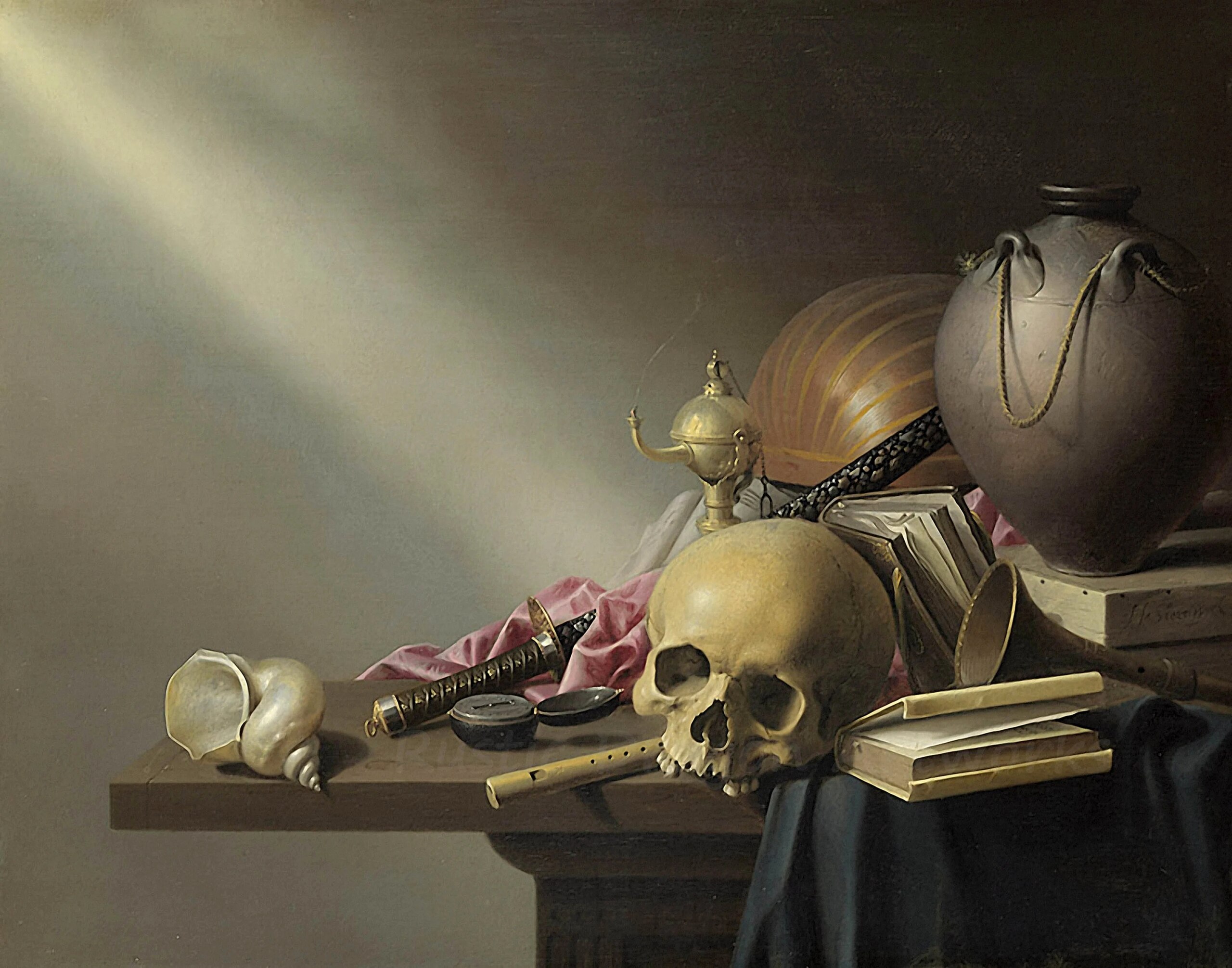
Vanitas Still-Life by Harmen Steenwijck (1640)

“There is not room for Death
Nor atom that his might could render void
Since thou art Being and Breath
And what thou art may never be destroyed.”

Emily Dickinson was a poet, a supposed recluse, an untethered free spirit. The woman in white. She wrote of immortality and legacy and hope, and yes, death. She wrote of funeral possessions and wild nights and bees and devotion. She was a revolutionary, a woman ahead of her own time, who wrote of her fears, aspirations, and beliefs with brazen honesty. Above everything else, she was loved.

She is laid to rest now in Amherst, Massachusetts, where she had lived all her life, with the rest of her family. Her words stay alive though, now more than ever. She did not see her words read by many before she passed, but her legacy endures.

Her life may have been short, but her words are eternal.

Acknowledgement: Each sub-section of this article begins with a verse from Emily Dickinson’s poem, “A Coffin is a Small Domain.”

Kick Up at a Hazard Table by Thomas Rowlandson (1787)

Why Do Good?: A Guide for Times When It’s Not Easy to Give a Shit

When you turn on your television to sift through the evening news after sitting on the couch with a glass of chardonnay which you have convinced yourself will be the only one tonight (because you need to ‘decompress’), you cannot help but sigh as you sink deep into the couch: “The world is on fire and it is only getting worse.”

This could easily have been a manifesto on why that is a loaded statement or how it would be better for everyone involved if you keep the bottle of chardonnay out of your arm’s reach. Though the sentiment is not erroneous either. There is so much absurdity happening all over the globe
with much of it providing a reasonable explanation for despair, ethical quandaries, and mental disorders that plague an entire generation.

Trauma has become generational, and each younger generation is inheriting a borrowed world where there seems to be a constant and consistent erosion of authentic values and morals. Of course, one can also argue the essentiality of the doctrines of relativism on ‘no absolute truth’, which emphatically suggest that the power vested in perceiving something in relation to another and proclaiming it right or wrong is firmly rooted in the context attributed to it and influenced by motivators of convictions, conventions, and abstraction from a form of a vantage point.

You might feel that society is on a decline and there are tidings of it getting much worse. Or perhaps you are tired and blue because even if you try to remain a good person, you have experiences every day that make you lose faith in humanity. Maybe you do not see any merit in trying because nobody else seems to care about it.

It is also conceivable that you do not feel that there is any meaning to the life or existence of a deity and you do not have the religious crutch of fear-mongering to force you into acts of conceived selflessness. Chances are you are just sick of it all and each passing day edges you firmly into an attitude of dismissal. It has become difficult to care.

Why be good amidst despair?

Why do good then? Why be a good person? Why bother to attempt goodness when there is no scoring system in place that rewards you for it? Why make the effort in the face of convenience and blissful ignorance? An answer to that, if this writer be so bold to eschew is that for better or worse, “We live in a society.”, and that perhaps should promulgate an attitude simpler to understand than “It is the right thing to do.”

As the popular saying goes, you can take a horse to the lake but you cannot make it drink water. Contrary to what is propagated in several forms of media these days, there is some merit in thinking that a person will be a good person, and actively care about being good when they want to be good, rather than them being told they should be good. We are a species of everlasting wonder that way. And it is difficult to care when you are
disillusioned.

A contractualist point of view is eschewed by T. M. Scanlon in his book What We Owe Each Other, a fascinating exploration of morality, ethics, and how they are justifiable while giving strong arguments to the titular aphorism. Scanlon believes in the plurality of moral and non-moral values. His theories suggest that the fairness of a moral decision and motives can be well understood by a system of mutual justification and criticism. Simply put, if what you do is justifiable to all the others involved, right or wrong, it should not be an issue.

So how does it all come together then? We live in a world full of diversity in its human populace in all ways conceivable. Some of us are misanthropes, some religious. Some anarchists or liberals or fascists or socialists. Some have no time to formulate an opinion and some cannot resist making one. The differences in our basic biology to the differences in our upbringings. There are more distinguishers and demarcations than this writer can mention, and yet there is still a common denominator that threads every single one of us into a group. The human condition. We are all in this together, this condition of existence.

And the simple fact of the matter is, all of it becomes so much easier to bear when you try to be good. Because as a species of carbon-based bipedalists evolutionarily gifted with intelligence, it is what we owe to each other. A discussion of what constitutes moral or not proves an interesting leeway for many of us to skirt responsibility, an attitude that has been on a rise for the last couple of decades. It has allowed us to bring up walls of comfort around our lives and stay ignorant of the realities of how our actions affect those around us because they do.

While a more robust discussion of the merits and demerits of relativism and contractualism is beyond the scope of this article, it is the hope of this writer that whatever your stance is on morality and responsibility in society, you see the need for more kindness in this world. The human condition unites us, and with a system of mutual goodness, it instills some meaning into the mundane, making life bearable. A little empathy goes a long way. A random act of kindness might just bring a smile to somebody’s face.

A character in The Good Place, a show that captures the zeitgeist of this chief philosophy and one of the finest pieces of media to emerge in this century makes a very valid point about the same (it has an entire episode dedicated to themes of Scanlon’s book too!): “I argue that we choose to be good because of our bonds with other people and our innate desire to treat them with dignity. Simply put, we are not in this alone.”

The Good Place Season 1 Episode 6 Screenshot
The Good Place S1E06

Being good is not about being a goody-two-shoes or that annoying positive character in sitcoms who’s happy even when the world is falling apart around them (though do you really envy that?). Being good is not about being perfect. We might have the best intentions, and the relativists among you might just smile here, but we might still end up making a mess.

We are a flawed species, something that makes us even more endearing, along with the fact that we are capable of accomplishing unimaginable wonders when we actually do make an effort. Especially when there are more reasons not to.

Being good is about giving a shit. Might be a far reach or a coping mechanism, but being good, and spreading kindness? That might just make the pains of existence sweeter.

Powered by WordPress & Theme by Anders Norén